
Choosing the right Battery Storage Cabinet is a safety decision, not merely a purchasing task. A cabinet may look sturdy in a showroom, yet perform poorly beside a workshop door or under direct sunlight. The best choice depends on battery chemistry, storage quantity, charging habits, available space, and workplace conditions.
This guide examines ten practical tips for evaluating cabinet construction, fire protection, ventilation, temperature control, spill containment, access control, and warning labels. It also considers load capacity and shelf spacing, because heavy battery packs can strain weak supports. A reliable cabinet should have clear technical documentation, tested materials, and instructions that staff can understand during a stressful incident. Manufacturer guidance matters. So does advice from qualified fire-safety and electrical professionals.
Small details reveal quality. Check whether doors close smoothly, hinges remain firm, and cables avoid sharp edges. Measure the storage area before ordering. Leave room for inspection and emergency access. Do not assume a larger cabinet is automatically safer. It may encourage overloading or poor organization. That assumption deserves scrutiny.
Real workplaces are imperfect. Batteries arrive with different shapes, labels, and charging histories. Dust gathers. Records become incomplete. Therefore, selection should include routine inspections, staff training, and a documented maintenance plan. This article offers a practical framework, but it cannot replace site-specific risk assessment or current local requirements. The safest decision combines verified product information, hands-on observation, and cautious professional judgment.
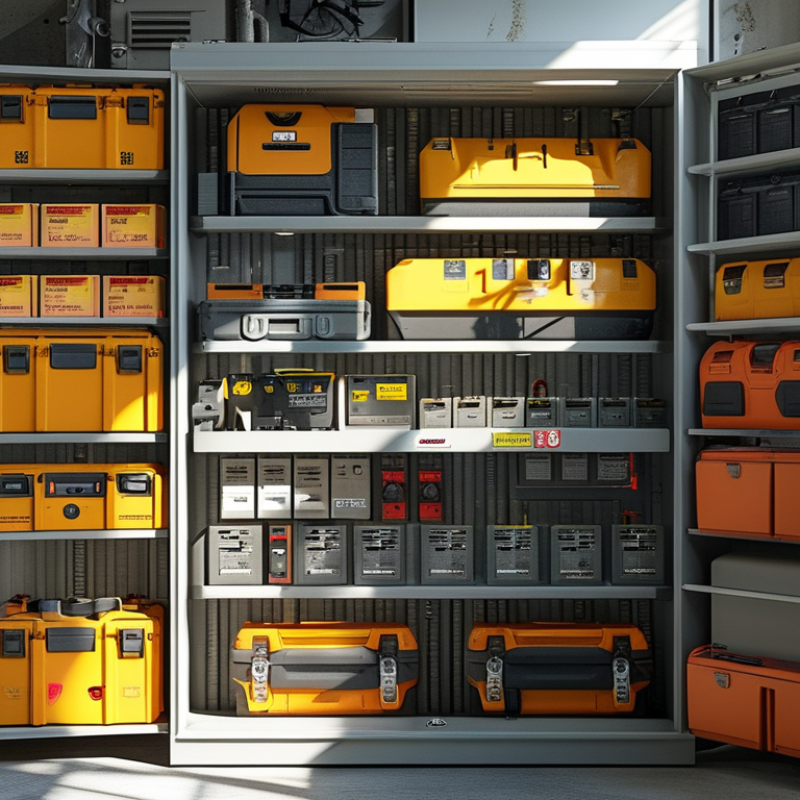
Before choosing a battery storage cabinet, define exactly what it must protect and support. Record the battery chemistry, quantity, dimensions, weight, voltage, and charging frequency. Include cable types and connector positions. Small details matter. A cabinet for spare batteries differs from one used during active charging. These uses create different heat, access, and monitoring requirements.
Inspect the intended room carefully. Measure the doorway, aisle width, ceiling height, and floor capacity. A fully loaded cabinet can be surprisingly heavy. Keep it away from leaking pipes, direct sunlight, heaters, and vehicle routes. If charging occurs inside, check ventilation, temperature control, alarm coverage, and local fire requirements. In practical site assessments, overlooked water lines often create serious storage risks. The cabinet should also have secure doors, clear labels, and controlled access. Avoid placing unrelated materials nearby.
Choose internal features that match daily handling. Adjustable shelves help when battery sizes change. Spill containment, cable routing, and emergency isolation can improve control during inspections. Ask for verified load capacity and documented fire performance. Do not rely on appearance alone. A thick steel cabinet may still lack suitable ventilation or internal separation. I have seen teams buy oversized cabinets, then struggle with poor access and wasted floor space. That mistake is expensive. Recheck the storage plan after several months, because battery quantities often change faster than expected.
The chart shows typical battery energy scales by application to support early cabinet planning. Small tool batteries may require compact storage, while residential backup, telecom, commercial UPS, and EV-buffer systems require progressively greater capacity, ventilation, access control, and fire-safety planning. Confirm the final cabinet specification against the battery manufacturer’s requirements, applicable electrical codes, and local fire regulations.
Choosing a battery storage cabinet starts with the battery chemistry, not the cabinet’s appearance. Lithium-ion, lead-acid, and other chemistries create different heat, ventilation, and protection needs.
A mismatch can reduce service life or create unsafe operating conditions.
Capacity matters just as much.
Crowded shelves look efficient, but they complicate maintenance. Measure the actual battery dimensions. Small errors happen. I once underestimated connector clearance, making installation unnecessarily difficult.
Compatibility includes more than physical fit.
A cabinet may meet its published capacity, yet perform poorly in a hot, dusty space. Ask for test records, installation guidance, and clear maintenance procedures. Reliable documentation matters as much as strong steel.
10 Tips for Choosing a Battery Storage Cabinet
Assess Fire Protection, Ventilation, and Spill Control Features
A battery cabinet should control hazards before they become emergencies. Look for fire-resistant construction, self-closing doors, and sealed joints. A strong cabinet is not automatically fire-safe. Ask for tested performance data and clear installation limits.
Check whether the cabinet includes temperature monitoring and an audible alarm. Sensors should be easy to test during routine inspections. Keep heat-producing batteries away from direct sunlight, heaters, and crowded electrical areas. Ventilation matters too. Lead-acid batteries may release hydrogen during charging, so the cabinet needs suitable airflow or approved extraction. Never assume ordinary room ventilation is enough.
Spill control needs equal attention. Select a cabinet with a deep, chemically resistant sump. The tray should contain electrolyte from the largest stored battery. Check seams, drain plugs, and tray capacity. Small cracks can remain hidden beneath dust. Add compatible absorbent materials nearby, but do not store loose items where they block ventilation.
Use noncombustible shelves and prevent batteries from touching metal surfaces unnecessarily. Maintain separation between damaged, swollen, or leaking units and normal stock. A written inspection log can reveal repeated temperature or leakage problems. Record dates, findings, and corrective actions. This sounds tedious. It is still valuable.
Ask a qualified safety professional to review the cabinet, charging practice, and local requirements together. A cabinet may meet one need while creating another. For example, a sealed design can reduce spills but restrict airflow. Recheck the choice after real use, especially when battery sizes or charging routines change.
| Tip | Assessment Dimension | What to Check | Practical Selection Criteria | Why It Matters | Evidence to Request | Priority |
|---|---|---|---|---|---|---|
| 1 | Battery Chemistry and Use Case | Identify whether the cabinet will store lithium-ion, lead-acid, nickel-based, or mixed battery types. Record battery voltage, capacity, chemistry, and charging status. | Choose a cabinet specifically evaluated for the intended battery chemistry and storage or charging activity. Do not assume that a cabinet designed for passive storage is suitable for charging. | Thermal runaway, hydrogen generation, electrolyte leakage, and charging hazards vary significantly by chemistry and operating condition. | Battery datasheets, safety data sheets, charging instructions, and the cabinet’s stated application limits. | High |
| 2 | Fire-Resistance and Internal Fire Protection | Review the cabinet’s fire-resistance construction, fire-rated doors, seams, shelves, insulation, and penetration details. | Prefer independently tested or listed construction with a clearly stated fire-resistance period. The required rating should be confirmed with the authority having jurisdiction and the applicable building or fire code. | A fire-rated enclosure can delay heat and flame spread, helping protect people, escape routes, and nearby equipment. | Third-party test reports, listing documentation, fire-rating certificate, construction drawings, and installation restrictions. | High |
| 3 | Thermal Runaway Testing | Determine whether the cabinet or the complete battery-storage system has been evaluated for cell failure, fire propagation, smoke release, and heat exposure. | For lithium-ion applications, request test information based on recognized large-scale battery fire-test methods, such as UL 9540A, where applicable. Confirm that the tested configuration matches the proposed batteries and cabinet layout. | A test performed on a different battery module or enclosure may not represent the behavior of the planned installation. | Test report, tested battery configuration, module spacing, maximum energy capacity, ventilation arrangement, and test limitations. | High |
| 4 | Ventilation and Gas Management | Check whether the cabinet uses natural or mechanical ventilation and whether airflow is compatible with the stored battery chemistry. | For lead-acid batteries, hydrogen is flammable at approximately 4% by volume in air; ventilation should be designed to keep concentrations well below the lower explosive limit. For lithium-ion batteries, evaluate possible flammable or toxic off-gases and follow the approved system design. | Insufficient ventilation can allow flammable gas accumulation, hazardous atmospheres, corrosion, or unsafe heat buildup. | Ventilation calculations, fan specifications, airflow direction, exhaust termination details, alarm setpoints, and electrical classification information where required. | High |
| 5 | Temperature Monitoring and Thermal Control | Inspect the cabinet’s temperature sensors, alarm functions, cooling provisions, and protection against overheating during charging. | Use the battery manufacturer’s specified operating and charging temperature range. Select a cabinet that can identify abnormal temperature rise and initiate the required alarm or shutdown response. | High temperature accelerates battery degradation and can increase the likelihood of thermal failure, especially during charging. | Sensor accuracy, alarm thresholds, data-logging capability, emergency shutdown interface, and commissioning test procedure. | High |
| 6 | Fire Detection and Suppression Interface | Assess smoke, heat, flame, gas, and temperature detection options, as well as compatibility with building fire alarms and suppression systems. | Detection should be suitable for the battery chemistry and cabinet environment. Any automatic suppression system should be engineered for the expected hazard and should not be treated as a substitute for code compliance or safe separation. | Early detection can provide warning before a small incident becomes a cabinet-wide or room-wide event. | Detector type, alarm sequence, notification method, suppression design basis, maintenance schedule, and integration diagrams. | High |
| 7 | Spill Containment and Electrolyte Control | Check for a sealed base, raised lip, removable spill tray, chemically resistant coating, and safe drainage or collection provisions. | The containment volume should be calculated from the maximum credible electrolyte release and the applicable local environmental, fire, and workplace requirements. Do not rely on an unverified “universal” containment percentage. | Electrolyte can be corrosive, harmful to people, damaging to floors, and incompatible with ordinary metal or coating materials. | Containment-volume calculation, material compatibility chart, spill-response instructions, tray removal method, and disposal procedure. | High |
| 8 | Storage Capacity, Weight, and Clearances | Verify shelf load ratings, cabinet payload, battery dimensions, cable routing, door swing, aisle clearance, and ventilation clearance. | Keep the total battery weight below the certified shelf and cabinet limits. Maintain the manufacturer’s required clearances and provide enough space for inspection, lifting, and emergency access. | Overloaded shelves can fail mechanically, while inadequate clearance can obstruct cooling, maintenance, and emergency response. | Load-rating label, shelf deflection data, dimensional drawing, center-of-gravity limits, anchoring details, and clearance requirements. | Medium |
| 9 | Electrical Safety and Charging Controls | Review cable entry points, grounding and bonding, overcurrent protection, charger compatibility, emergency disconnects, and protection against damaged leads. | Use correctly rated components for the system voltage, current, fault level, and environmental conditions. Charging equipment should include appropriate control, monitoring, and fault protection. | Charging faults, short circuits, damaged cables, and poor grounding can create shock, arc, fire, or equipment-damage hazards. | Electrical schematic, charger specifications, grounding test results, disconnect location, overcurrent-device ratings, and inspection checklist. | High |
| 10 | Location, Inspection, and Emergency Response | Evaluate placement near exits, ignition sources, combustible materials, sprinkler systems, heat sources, public areas, and emergency-access routes. | Install the cabinet in a controlled, dry, well-marked area according to the applicable fire, electrical, building, environmental, and workplace requirements. Establish routine inspection and incident-response procedures before use. | A suitable cabinet can still create unacceptable risk if it is installed in an unsuitable location or if staff do not know how to isolate and report an incident. | Site risk assessment, approval from the authority having jurisdiction, emergency plan, inspection log, training records, signage, and maintenance schedule. | High |
Note: Final cabinet selection and installation should be verified against the battery manufacturer’s instructions, applicable fire and building codes, electrical requirements, environmental rules, and approval requirements of the local authority having jurisdiction.
Tip 1: Measure the battery footprint, including terminals, cables, and ventilation gaps. A cabinet that barely fits becomes difficult to inspect.
Tip 2: Leave room for future modules.
Tip 3: Check the cabinet’s weight rating against fully loaded shelves, not empty frames.
Tip 4: Keep heavier batteries low to improve stability. A small error matters.
Tip 5: Choose shelves that support the battery shape without blocking airflow.
Tip 6: Separate battery groups when maintenance, chemistry, or operating conditions differ.
Tip 7: Plan cable paths before installation. Sharp bends and crowded terminals can slow emergency access.
Tip 8: Use clear labels and visible status information. From practical installation work, I have found that poor labeling causes more hesitation than expected. It is easy to underestimate this detail.
Tip 9: Select doors based on the room layout. Front access may suit a narrow service aisle, while side access can simplify testing. Check the opening angle near walls, racks, and escape routes.
Tip 10: Consider locking, ventilation, fire detection, and environmental controls according to local requirements and a qualified assessment. Do not treat access control as an afterthought. Technicians need secure access, but they also need enough space to work safely.
I would also review the layout after a trial installation. Drawings can miss real cable lengths, hand clearance, or an awkward door swing. That reflection often improves the final cabinet choice.
Tip 1: Verify the cabinet’s compliance documents before comparing prices. Confirm that its construction, fire performance, electrical protection, and environmental rating match the standards required in your location. Standards differ by country and installation type. Ask for current test reports, not just marketing statements. A missing document is a warning sign.
Tip 2: Review installation requirements with a qualified electrical professional. Measure doorways, floor space, service clearances, and the cabinet’s filled weight. Check whether the floor can support it safely. Ventilation may be necessary, especially in warm rooms or areas with limited airflow. Keep the cabinet away from water, direct sunlight, combustible materials, and blocked exit routes. Installation drawings often look simple, but real rooms rarely cooperate.
Tip 3: Study the maintenance plan before purchase. Confirm inspection intervals, access to internal components, recommended temperature ranges, and replacement procedures. Ask how alarms are tested and where service records are stored. A cabinet with clear labeling saves time during an emergency inspection. Record battery condition, connection tightness, dust levels, and visible corrosion. Small defects can become expensive problems.
Experience also matters. A technically compliant cabinet may still be unsuitable for a dusty workshop or a narrow utility room. Recheck assumptions during a site visit. I have found that overlooked clearance measurements can delay installation more than equipment delivery. Choose a design that trained staff can inspect safely and consistently. Reliability depends on both the cabinet and the habits surrounding it.
This website uses cookies. By continuing to browse this site you are agreeing to our use of cookies. Please review our Privacy Policy for more information.