
Machine Guarding Doors are more than panels placed around moving equipment. They create a controlled boundary between people and hazards such as rotating shafts, pinch points, and flying chips. A well-designed door also supports practical work. Operators need to inspect parts, clear routine obstructions, and reach controls without awkward movements.
The door’s details matter. Consider a sliding panel with a clear viewing window, a sturdy handle, and a safety interlock. Its track should move smoothly, even when dust gathers near the frame. The interlock should prevent hazardous motion when the door opens, as required by the machine’s risk assessment and applicable safety standards. Small installation choices can change how reliably the system works.
I can’t responsibly attribute a quotation to a named industry expert without a verifiable source. For a reliable reference point, OSHA’s machine-guarding rule states: “One or more methods of machine guarding shall be provided to protect the operator and other employees in the machine area from hazards.” That is regulatory language, not a personal expert quotation. This distinction matters.
A useful guide should explain door types, interlocks, materials, and maintenance in plain terms. It should also acknowledge trade-offs. A door that is secure but difficult to open may encourage workarounds. That deserves reflection. Good guarding depends on sound design, careful installation, and workers who can use the system as intended.
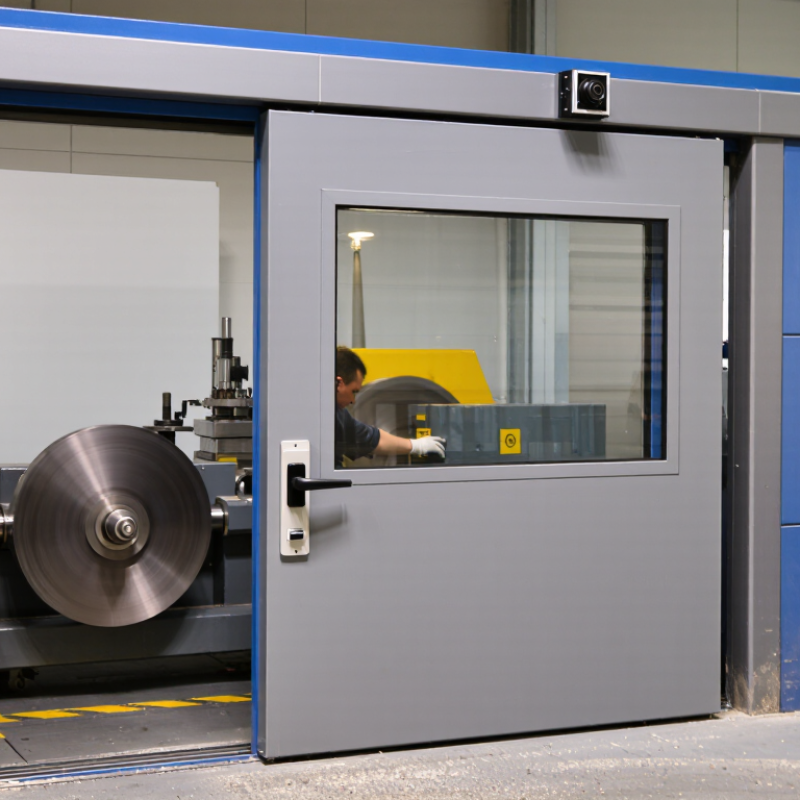
A machine guarding door is a movable barrier built into or attached to a machine’s protective enclosure. It gives workers controlled access to areas where moving parts, cutting tools, or hot surfaces may create hazards. Common details include a hinged steel frame, mesh panels, a clear viewing window, and a latch. The exact design depends on the machine and the work performed.
Its main purpose is to keep people away from danger during operation. Some doors use an interlock that signals the machine to stop when the door opens. Others remain locked until hazardous movement has ceased.
A door is not a magic fix.
Stopping distances, stored energy, and the machine’s control system all affect how protection works. A qualified risk assessment helps identify suitable safeguards.
Doors also support routine tasks, such as loading parts or inspecting a tool. For example, an operator may need to open a side panel to remove a finished component. The opening should be practical without exposing nearby workers to moving mechanisms. Poorly placed handles or doors that swing into walkways can create new problems.
And interlocks need regular checks; a sensor can become misaligned after repeated use.
Small details matter. A clear window may also help workers spot a jam without opening the enclosure.
A machine guarding door is a movable barrier that limits access to hazards such as a rotating chuck or press ram. Its performance depends on more than the panel. A rigid frame, secure hinges, a handle or latch, and an interlocking switch work as one system. The switch detects the door’s position; a safety relay or controller then prevents startup or commands a stop when the door opens.
Small parts matter. OSHA’s machine-guarding standard, 29 CFR 1910.212, identifies hazards including points of operation and ingoing nip points.
In practice, the door must remain aligned through repeated opening, vibration, and cleaning. A misaligned latch can leave a gap or prevent reliable sensing. Where machinery takes time to stop, an interlock alone may not make access safe; guard locking can keep the door closed until motion ends.
BLS’s 2023 Census of Fatal Occupational Injuries recorded 738 worker deaths from contact with objects and equipment. This broad category is not limited to machine guarding, but it highlights the importance of controlling access. Check stopping time, reach-through risks, and stored energy during risk assessment.
Not foolproof. Operators may defeat a door that slows routine work, so practical access and clear visibility matter alongside dependable sensing. Verify the system during maintenance.
Machine guarding doors provide access to hazardous areas while helping keep hands and clothing away from moving parts. Hinged doors are common on compact machines. They swing open for cleaning or setup, but need clear space and sturdy hinges. A door that opens into a busy walkway can create a problem.
Sliding doors suit work cells with limited floor space. Their panels travel along tracks, so operators can reach the machine without a wide swing area. Tracks need regular cleaning; chips and dust can make movement rough. Lift-up doors move vertically and are useful above loading points, though their weight and travel path need careful attention.
Some doors use an interlock that stops or prevents machine operation when the door opens. This is a safety feature, not a door style, and it should match the machine’s hazards and access needs. Removable panels can work where access is infrequent, but they are less convenient for routine checks. Space matters. In practice, choosing a door is not just about the opening. Handle position, visibility, cleaning access, and the operator’s reach all affect whether it gets used properly. A tidy design on paper may still feel awkward beside a real production line.
Machine guarding doors provide controlled access to hazardous areas around equipment. Their safety interlocks connect the door’s position to the machine’s control system. When the door opens, the system should stop or prevent hazardous motion, depending on the machine’s design and risk assessment. A closed door alone is not proof of safety. The interlock must be correctly selected, installed, and tested.
Access control also shapes everyday work. A maintenance technician may need a key or authorized release to enter an enclosure, while operators use the door only for approved tasks. Choose equipment suited to the environment, such as washdown areas or dusty production lines. Check that hinges, latches, and sensors remain aligned after repeated use. A small gap can matter. Procedures should explain what happens during faults and maintenance, and workers need practical training. In real facilities, people may find workarounds when access is awkward; that possibility deserves honest attention.
Tips: Inspect interlocks on a planned schedule. Test door-opening responses using the manufacturer’s procedure, and record faults or adjustments. Never treat an interlock as a substitute for isolation during servicing. If a door sticks or a sensor behaves inconsistently, keep the area out of normal operation until a qualified person assesses it. A quick check helps, but it is not a complete safety review.
| Guard Door Type | How Access Is Controlled | Typical Safety Function | Common Application | Key Design Considerations |
|---|---|---|---|---|
| Interlocking guard door | A safety switch detects whether the door is open or closed. | Opening the door initiates a stop or prevents hazardous operation, depending on the machine’s safety design. | Machines where hazardous motion stops quickly enough for access to be controlled without locking the door. | Assess stopping time, access to hazards, switch positioning, and the risk of defeat or misalignment. |
| Guard door with guard locking | An interlock keeps the door locked until a defined release condition is met. | Prevents access while hazardous movement or another hazardous condition remains. | Equipment with a long stopping time or hazards that remain after the stop command. | Choose a suitable release condition, such as verified standstill or a safely evaluated time delay; account for emergency escape where needed. |
| Hinged door with a coded safety switch | A coded actuator is recognized by a compatible safety switch when the door is closed. | Provides a safety-related door-position signal to the machine control system. | Frequently accessed doors where alignment, vibration, or straightforward actuator substitution is a concern. | Coding does not eliminate the need for risk assessment, correct installation, and measures against foreseeable defeat. |
| Sliding guard door | A safety interlock monitors the closed position; guard locking may also be fitted. | Prevents or stops hazardous operation when the guard is not in its safe position. | Large openings on production cells, conveyors, and automated equipment. | Ensure the door cannot be easily bypassed, remains aligned, and provides adequate coverage of the hazard area. |
| Access door with a trapped-key system | A key sequence controls access and can help ensure that a key is removed before entry. | Can support an isolation or access-control sequence when correctly designed into the safety system. | Selected maintenance or process areas where a defined sequence of operations is appropriate. | A key sequence alone is not necessarily energy isolation. Apply appropriate lockout and energy-control procedures for servicing. |
| Guard door with monitored emergency escape release | A release allows a person inside an enclosed area to open a locked door; its status is monitored as required by the design. | Supports escape from an enclosed hazardous area without treating the release as a normal access method. | Large enclosures or areas where a person could be inside while the door is locked. | Provide suitable escape arrangements based on the risk assessment and ensure opening the door brings the machine to a safe state. |
| Door with ordinary access control only | A badge, keypad, or other access credential controls who can open the door. | Controls entry permissions but does not, by itself, perform a machine safety function. | Personnel management or restricted-area access when used alongside appropriate safeguarding. | Do not rely on ordinary access control as a substitute for a safety-rated guard interlock or energy-isolation procedure. |
Safety note: The appropriate guard, interlock, and control-system performance depend on the machine-specific risk assessment. Design, installation, and validation should follow applicable local regulations and relevant standards, such as ISO 14119 for interlocking devices associated with guards and ISO 13849-1 for safety-related parts of control systems.
Machine guarding doors are used where operators need access to hazardous machinery for loading, adjustment, or cleaning. Typical settings include CNC machining cells, robotic work areas, and automated packaging lines. A closed door can limit access to moving parts, but its value depends on the hazard and the way people work.
OSHA’s FY2023 Top 10 cited standards report recorded 1,644 citations for machine guarding under 29 CFR 1910.212. That figure reflects cited violations, not injury totals; it still shows that guarding remains a practical concern.
Selection should start with the task, not the door style.
Map where hands, tools, and materials enter the danger zone. Then consider opening frequency, visibility, cleaning needs, impact exposure, and how quickly the machine stops. An interlocked door may suit frequent access, while a fixed panel may work better where entry is rare.
Fit matters. Check that hinges, handles, and fasteners withstand daily use, and confirm that the door cannot be easily bypassed.
One assumption deserves scrutiny: an interlock alone does not make every setup safe. Verify the machine’s stopping behavior and test the guard during normal work cycles. A door that slows routine access may invite workarounds, so observe operators using it before finalizing the design.
This website uses cookies. By continuing to browse this site you are agreeing to our use of cookies. Please review our Privacy Policy for more information.
