2026 How to Choose the Best Lithium Battery for Your Needs?
In recent years, the lithium battery market has seen significant growth. According to a report from MarketsandMarkets, the global lithium-ion battery market is projected to reach $129 billion by 2027. This surge reflects the rising demand in sectors like electric vehicles and renewable energy storage. Choosing the best lithium battery for your needs is crucial for efficiency and longevity.
Industry expert Dr. Rachel Chen states, “Selecting the right lithium battery can maximize performance and minimize costs.” This encapsulates the importance of informed decision-making in an industry driven by rapid technological advancements. Consumers must consider various factors, including capacity, discharge rate, and lifecycle.
The increasing complexity of lithium battery options can overwhelm buyers. There is no one-size-fits-all solution. Each application demands a different type of battery characteristics. Understanding these nuances is essential for effective use. While the data is promising, potential buyers should also reflect on their specific needs and future goals.

Understanding Lithium Battery Basics and Types
When considering lithium batteries, it's crucial to understand the basics. Lithium batteries come in various types, including lithium-ion and lithium polymer. Each type serves different purposes. Lithium-ion batteries are commonly used in electronics. They offer high energy density and longevity. However, they can be sensitive to high temperatures.
Lithium polymer batteries are lightweight and flexible. They are often found in drones and RC vehicles. While they provide versatility, they may have a shorter lifespan. It's essential to weigh these differences based on your needs.
Battery capacity, measured in amp-hours (Ah), is another key factor. A higher capacity means longer run times but also heavier weight. People often overlook this balance. Safety features, like a built-in protection circuit, should not be ignored either. These features can prevent overcharging. Yet sometimes, manufacturers skimp on them to cut costs. Choices must be made carefully to avoid future frustrations.
Evaluating Capacity and Energy Density for Your Applications
When selecting a lithium battery, capacity and energy density play crucial roles. Capacity is measured in
amp-hours (Ah). It refers to how much charge a battery can hold. A higher capacity means
longer usage before needing to recharge. For example, a 50Ah battery can power a device for twice as long as a 25Ah battery.
Energy density, on the other hand, is about how much energy is stored in a specific weight or volume. Batteries with higher energy density provide
more power without adding extra weight. This is critical for portable devices and electric vehicles. Imagine carrying a lightweight battery that
lasts all day versus a heavy one that drains quickly.
However, not every situation requires the highest capacity or energy density. It’s worth considering what fits your specific needs. Some applications
might prioritize weight over runtime. Others must balance both features. Reflecting on the trade-offs ensures you choose wisely. Sometimes, a lower capacity
battery is more than enough for casual use. Ask yourself what you really need before making a choice.
Assessing Voltage Requirements for Different Devices
When choosing a lithium battery, voltage requirements play a crucial role. Different devices operate at varying voltage levels. For example, smartphones typically use 3.7 volts. In contrast, power tools may require 18 volts. Ensuring the battery matches your device’s voltage is essential for optimal performance.
Tips for assessing voltage needs: Check the device’s specifications. Look for the battery type and voltage range. Always use a compatible battery to avoid damaging your devices.
Another factor to consider is the discharge rate. Some devices need a higher discharge rate for short bursts, like cameras during flash usage. Others may require a steady discharge for smooth operation. This difference can affect how long your battery lasts.
Tips for discharge rates: Research your device’s power demands. Understand when you need high bursts versus steady power. It's important to note that a mismatch can lead to inefficient performance or potential harm to the device.
Comparing Cycle Life and Charging Performance
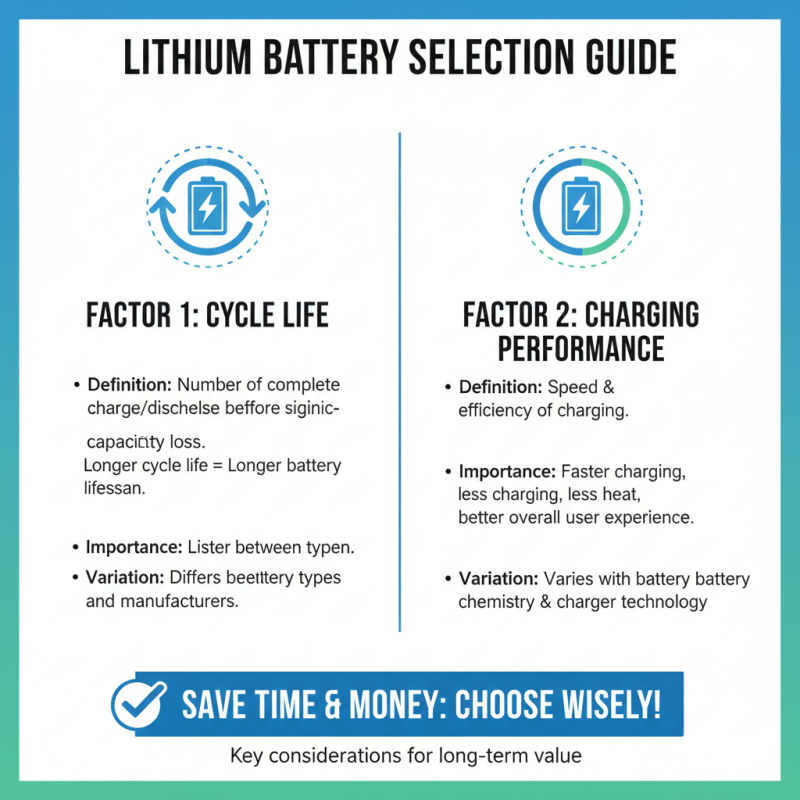
When choosing a lithium battery, cycle life and charging performance are crucial factors. Cycle life refers to the number of charge and discharge cycles a battery can undergo before its capacity significantly diminishes. A battery with a longer cycle life will last longer. You might think that all lithium batteries have similar cycle lives. However, there are differences that can affect your decision. Knowing these variants can save you time and money.
Charging performance plays a vital role too. Fast charging capabilities are appealing, but they can impact battery longevity. If your needs require quick recharges, you’ll want to weigh fast charging against potential long-term effects. Some batteries tolerate rapid charging well; others do not. Using a battery that charges too quickly may impact overall performance over time.
Taking a closer look at these aspects helps refine your choices. Some users learn through trial and error, which is fine but can be costly. Reflect on your own needs. Do you prioritize longevity or fast charging? Understanding this can lead you to a more suitable battery choice. Choosing the right lithium battery isn't just about numbers; it's about how it fits into your everyday life.
Considering Safety Features and Environmental Impact
When choosing a lithium battery, safety features and environmental impact are crucial. Look for batteries with built-in protective circuits. These circuits can prevent overcharging and overheating. They can save you from potential hazards. Additionally, consider the battery's materials. Toxic substances can harm the planet. Opt for manufacturers who prioritize eco-friendly practices.
Tips: Always check if the battery is certified. Certifications ensure that the product meets safety standards. This reduces risks significantly. Research the battery's lifecycle impact. A battery that lasts longer is often a better choice for the environment. Short-lived batteries contribute to more waste.
Another point to think about is disposal. Some lithium batteries are recyclable, while others are not. Improper disposal can lead to environmental damage. It's wise to choose batteries from companies that offer take-back programs. This helps mitigate the negative impact on our planet. Ultimately, your choices matter. Make informed decisions.
2026 How to Choose the Best Lithium Battery for Your Needs? - Considering Safety Features and Environmental Impact
| Battery Type |
Capacity (Ah) |
Voltage (V) |
Weight (kg) |
Safety Features |
Environmental Impact |
| Lithium Iron Phosphate |
100 |
12.8 |
12 |
Overcharge Protection, Thermal Management |
Recyclable, Lower Toxicity |
| Lithium Polymer |
50 |
3.7 |
0.5 |
Short Circuit Protection, Overcurrent Protection |
Less Waste, Can be Recycled |
| Lithium Nickel Manganese Cobalt |
75 |
3.7 |
1 |
Cell Balancing, Temperature Monitoring |
Requires Rare Metals, Limited Recycling Options |
| Lithium Cobalt Oxide |
60 |
3.7 |
0.8 |
Overheat Protection, Overcharge Protection |
High Toxicity, Special Disposal Requirements |