
Choosing Firefighting Drones is no longer a futuristic exercise. It is a practical decision for departments facing fast-moving fires, limited visibility, and dangerous access routes. The National Interagency Fire Center recorded 56,580 U.S. wildfires in 2023, burning more than 2.69 million acres. Those figures reveal the pressure on emergency teams. They also expose a difficult truth: a drone must perform when smoke hides the ridgeline and wind shifts without warning.
The National Fire Protection Association reported approximately 1.5 million U.S. fires in 2023. Fire caused about $27.2 billion in direct property damage. These numbers support stronger aerial intelligence, but technology alone cannot guarantee safer operations. Chief Charles Werner, founder of DroneResponders, describes drones as “a force multiplier for public safety agencies.” That phrase matters. A force multiplier still depends on trained crews, reliable communications, and disciplined mission planning.
This guide presents seven essential tips for evaluating Firefighting Drones. It examines thermal imaging, flight endurance, payload capacity, weather resistance, data links, training, and total ownership costs. MarketsandMarkets’ Drone Market report also identifies public safety as a growing application area, reflecting wider investment in emergency aerial systems. Yet market growth can encourage rushed purchases. I might overvalue camera resolution myself. A crisp image means little if the battery fails during evacuation.
The best choice is not always the most expensive aircraft. It is the platform that remains useful beside a smoky engine bay, on a wet landing zone, or above a dark forest edge. Reliability deserves more attention than impressive specifications.
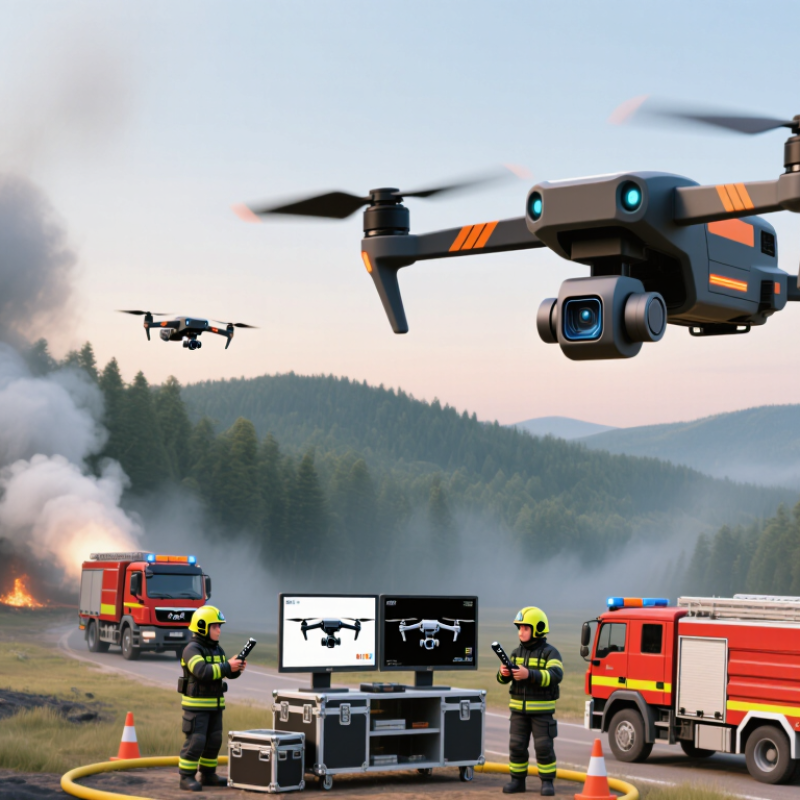
A firefighting drone should match the emergency, not the sales brochure. NFPA estimated 1.5 million fires in the United States during 2022, causing about 3,790 civilian deaths and $18.1 billion in property damage. These figures show why mission definition matters. A drone for wildfire mapping needs different endurance, sensors, and communications than one for a warehouse search.
Write the mission in operational terms. Will the aircraft locate trapped people, identify roof hotspots, map fire boundaries, or assess chemical risks? Record flight duration, thermal range, payload weight, and required image detail. A thermal camera may reveal heat behind smoke, but it cannot replace trained interpretation. That assumption is often wrong.
Study the environment before selecting equipment. Note wind, smoke density, power lines, narrow streets, reflective roofs, and nearby airports.
Wildfire Operations The National Interagency Fire Center reported more than 7.5 million acres burned by wildfires in the United States during 2023. Remote terrain demands stronger links and longer endurance.
Urban Operations Urban scenes demand precise positioning and obstacle awareness. The Federal Aviation Administration also emphasizes risk assessment, airspace awareness, and visual operating limitations for public-safety flights.
Test these conditions before deployment, not during a crisis. I would still repeat the test after heavy rain, because clean laboratory results can mislead field crews. A short flight can be enough. Sometimes.
Compare Drone Performance, Sensors, and Fire-Scene Intelligence
Firefighting drones must perform in smoke, wind, heat, and poor visibility. Start with flight endurance, wind resistance, payload capacity, and stable hovering. A short battery life can interrupt a roof inspection at the worst moment. NFPA’s Fire Loss in the United States During 2023 recorded about 1.39 million fires and 3,670 civilian fire deaths. That scale demands reliable aerial information, not impressive specifications alone.
Thermal sensors should reveal hidden hotspots behind walls, roofs, and dense smoke. However, thermal images can mislead when surfaces reflect heat or water cools burning materials. Pair infrared imaging with visible cameras, gas detection, and accurate location data. NIST research on public-safety unmanned aircraft emphasizes usable information, communication reliability, and operator workload. A drone that produces beautiful footage but delays decisions has limited value. Minutes matter.
Evaluate fire-scene intelligence, not only sensor resolution. Look for automatic hotspot marking, terrain mapping, live video sharing, and clear evidence storage. Test the system near metal structures, power lines, and moving vehicles. These environments expose weaknesses quickly. The National Fire Incident Reporting System shows that structure fires remain a recurring operational burden, with thousands of departments reporting incidents each year. I would not trust autonomy alone. Human review is still essential. Battery planning, radio coverage, and crew training also deserve equal attention. A practical field test may reveal less glamorous, but more important, failures.
A practical evaluation begins with safety, not camera resolution. Check whether thermal sensors remain readable through smoke, darkness, and sudden temperature changes. Test obstacle avoidance near towers, cables, and damaged structures. Small errors can become serious quickly. Review battery endurance under heavy wind and high heat. Ask for independent test records, not only performance claims. A clear maintenance schedule also reveals whether reliability is taken seriously.
Emergency resilience requires more than a strong airframe. Examine weather sealing against rain, ash, and dust. Confirm that the control link has encryption, signal redundancy, and clear warnings during interference. Test fail-safe actions, including controlled landing or return procedures after signal loss. Operators should receive realistic training, including night flights and poor visibility. Training matters greatly. Inspect the ground station, spare batteries, charging equipment, and replacement parts before purchase.
Reliability should be demonstrated under pressure. Request flight logs, fault histories, inspection intervals, and documented software updates. Independent technicians should be able to diagnose common failures without guesswork. I would also conduct a live exercise beside heat, smoke, and uneven terrain. Specifications often look excellent on paper. Field conditions are less polite. A drone may pass every advertised test yet struggle with turbulence or battery degradation. Record those weaknesses honestly, then decide whether backup equipment, extra pilots, or a different operating plan is necessary. No checklist is perfect. Regular review keeps safety decisions grounded in evidence.
Choosing firefighting drones starts with regulatory fit, not camera quality. Check local aviation rules, airspace limits, night-flight requirements, privacy duties, and emergency authorization procedures. In the United States, Part 107 generally requires a remote pilot certificate and recurrent training every 24 months. Public safety agencies may also need specific waivers or documented operating procedures. Requirements differ internationally, so copying another department’s checklist can create serious gaps.
NFPA’s Fire Loss in the United States During 2023 reported 1,388,500 fires, 3,670 civilian deaths, and $22.1 billion in property damage. Those figures justify careful deployment, not rushed experimentation.
Pilot training must reflect smoke, heat, darkness, wind, and poor radio coverage. Train beyond takeoff. Include thermal-image interpretation, battery decisions, lost-link procedures, crew communication, and safe landing near personnel. NIST public-safety UAS research emphasizes repeatable testing for communications, endurance, and payload performance.
Test the drone with the actual thermal sensor, lighting, batteries, and command software. Operational compatibility matters more than advertised flight time. Check ingress protection, heat tolerance, launch space, data export, and compatibility with incident-command systems.
A realistic drill may expose weaknesses quickly. I would not trust a perfect demonstration. Calm weather hides problems. During one exercise, a short battery warning changed the entire flight plan.
Build conservative margins, record failures honestly, and revise procedures after every training session.
7 Essential Tips for Choosing Firefighting Drones
Assess Maintenance Needs, Total Cost, and Long-Term Value
When selecting a firefighting drone, examine its maintenance routine as closely as its flight performance. A capable aircraft is useless if technicians cannot service it quickly. Ask for inspection schedules, spare-part availability, battery replacement guidance, and documented repair times. Maintenance evidence matters. Request service records from real operational users, not only laboratory claims.
Check how the drone performs after exposure to heat, smoke, dust, and water. Thermal cameras, obstacle sensors, and communication links may need frequent testing after demanding missions. Battery life also changes with age, temperature, and charging habits. Include these variables in your cost estimate. The purchase price is only one line.
Calculate training, software access, transport cases, insurance, storage, batteries, repairs, and annual testing. A lower-priced aircraft may create higher costs over five years. I once underestimated battery replacement expenses during a small emergency-response project. That mistake affected the budget and reduced readiness. Review warranty limits and service contracts carefully. Confirm who provides technical support and how long critical components remain available. Long-term value depends on dependable operation, not impressive specifications. Choose equipment that your team can maintain, document, and deploy safely under pressure. Personnel should also receive practical training in thermal imaging, flight planning, and emergency procedures. Without that discipline, advanced equipment can produce unreliable decisions.
Use this evaluation framework to compare firefighting drone systems without relying on brand-specific claims.
| Tip | Evaluation Dimension | What to Measure | Practical Screening Target | Long-Term Cost or Value Effect | Evidence to Request | Priority |
|---|---|---|---|---|---|---|
| 1 | Define the mission before selecting the aircraft | Mission type, operating environment, flight duration, payload, launch location, and required response time. | Document at least three mission scenarios, such as structure fires, wildland fires, and post-incident inspection, including maximum distance, altitude, wind, temperature, and payload requirements. | Prevents paying for capabilities that are not operationally required and reduces the risk of purchasing an unsuitable platform. | Written mission profile, field-test plan, operating limitations, and environmental performance data. | High |
| 2 | Assess flight endurance and battery logistics | Usable flight time, battery charging time, spare-battery quantity, battery storage conditions, and safe return-to-home behavior. | Calculate endurance using the intended payload and reserve capacity rather than the unloaded maximum. Plan battery rotation for continuous operations and include a defined landing reserve. | Batteries are consumable components. Replacement planning, charging equipment, storage, and transport can materially increase five-year ownership cost. | Battery cycle data, charging specifications, replacement intervals, transport requirements, and cold- or heat-weather performance results. | High |
| 3 | Match sensors to firefighting decisions | Thermal imaging, visible-light resolution, optical zoom, low-light capability, temperature measurement range, image stabilization, and data export. | Verify that the thermal camera can identify heat patterns, occupants, hot spots, and re-ignition risks at the distances used by the response team. Test performance at night, through smoke, and in changing weather. | Useful, interoperable data can improve situational awareness and reduce repeat flights. Unnecessary sensor packages increase acquisition, calibration, and repair costs. | Sample thermal and visible images, calibration procedure, measurement accuracy limits, geotagging details, and export formats. | High |
| 4 | Evaluate durability and environmental protection | Ingress protection, operating temperature, wind tolerance, dust exposure, rain tolerance, corrosion resistance, and crash survivability. | Use an ingress-protection rating appropriate to the operating environment and verify the exact test conditions. Do not treat a water-resistance rating as permission to fly in every type of rain or spray. | Rugged equipment can reduce downtime and repair frequency, but over-specification can raise purchase weight and cost. Environmental limits must be compatible with local deployment conditions. | Environmental test reports, maintenance restrictions after water or smoke exposure, replacement-part pricing, and repair turnaround commitments. | High |
| 5 | Compare maintenance requirements and serviceability | Inspection intervals, propeller and motor checks, firmware updates, sensor calibration, battery health checks, repair access, and spare-part availability. | Create a preventive-maintenance calendar covering pre-flight, post-flight, periodic, and post-incident inspections. Prefer field-replaceable components where safety and manufacturer procedures allow it. | Lower maintenance downtime improves fleet availability. Easy access to parts, manuals, diagnostics, and trained technicians can reduce labor and shipping costs. | Maintenance manual, inspection checklist, fault-code documentation, parts list, technician training requirements, and historical repair data. | High |
| 6 | Calculate total cost of ownership, not purchase price | Aircraft, batteries, payloads, charging systems, software, training, insurance, regulatory compliance, repairs, storage, connectivity, and residual value. | Use a five-year TCO model: acquisition cost + operating costs + scheduled maintenance + unscheduled repairs + battery replacement + training and compliance costs − expected residual value. | A lower purchase price may produce a higher total cost if the system requires frequent battery replacement, proprietary services, specialist repairs, or extensive downtime. | Five-year cost worksheet, software and service terms, training fees, battery pricing, warranty exclusions, insurance requirements, and repair labor rates. | High |
| 7 | Verify training, compliance, data security, and future support | Pilot qualification, emergency procedures, local airspace rules, remote identification requirements where applicable, data retention, cybersecurity, software support, and upgrade paths. | Require documented operator training, scenario-based exercises, legal approval before deployment, secure access controls, and a support plan covering the intended service life. | Strong governance reduces operational, legal, and data risks. A supported and upgradeable system is more likely to remain useful as regulations and mission needs change. | Training syllabus, regulatory checklist, cybersecurity documentation, data-storage policy, software-support period, update policy, and end-of-support notice procedure. | High |
Decision rule: Select the system with the best verified mission performance, availability, maintainability, and five-year total cost—not necessarily the lowest initial purchase price. All flight operations should comply with applicable aviation, emergency-response, privacy, and workplace-safety requirements.
This website uses cookies. By continuing to browse this site you are agreeing to our use of cookies. Please review our Privacy Policy for more information.
