
Choosing the best Pv Accessories in 2026 requires more than comparing prices. A connector, isolator, cable, fuse, mounting rail, or monitoring device can influence safety, yield, and maintenance costs. Small parts carry large consequences.
The IEA PVPS Trends 2024 report recorded more than 400 GW of new solar capacity worldwide in 2023. IRENA’s Renewable Capacity Statistics 2024 also reported solar as the fastest-growing renewable technology. This expansion increases demand for reliable accessories, but it also creates confusion. Product labels can look impressive. Field performance may tell another story.
Dr. Michael Köhl, a photovoltaic reliability researcher associated with IEA PVPS Task 13, has stated, “Reliability is a system property, not merely a module feature.” That principle should guide every purchasing decision. Buyers must examine certification, material quality, temperature ratings, compatibility, installation conditions, and supplier traceability. NREL’s photovoltaic reliability research repeatedly highlights the importance of connections, weather exposure, and long-term degradation. A cheaper accessory may save money today. It may also create avoidable service visits later. That shortcut is tempting. It is also risky.
This guide will compare the practical factors behind high-quality Pv Accessories, including electrical safety, mechanical strength, environmental resistance, warranty clarity, and lifecycle value. The process will not be perfect. Manufacturer claims still require verification. Real projects contain dust, heat, uneven roofs, rushed installations, and human mistakes. Good selection means planning for those realities, not ignoring them.
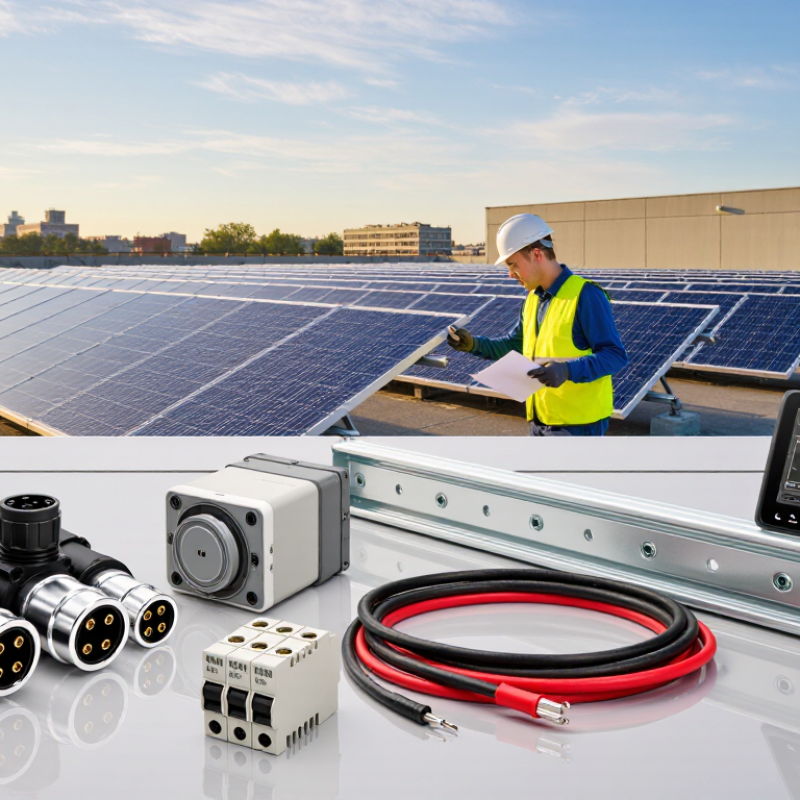
PV accessories are the supporting components that make a solar system safe, stable, and serviceable. They include mounting rails, clamps, DC cables, connectors, fuses, isolators, combiner boxes, grounding devices, surge protection, and monitoring equipment. Panels generate electricity, but accessories control how that electricity moves.
Their role extends beyond connection. Mounting hardware resists wind and thermal movement, while correctly sized cables reduce voltage loss and overheating. Protection devices interrupt abnormal currents and help limit damage from surges. IEC 62548 addresses photovoltaic array design, wiring, and protection requirements. IEC 61730 also covers module safety, but the wider system still depends on correctly selected accessories. Small parts matter.
The market is expanding quickly. IRENA’s Renewable Capacity Statistics 2024 reported 346 gigawatts of new solar capacity added globally during 2023. More installations mean more roofs, climates, cable routes, and maintenance conditions to consider. During field inspections, loose connectors and poorly supported cables remain practical warning signs. A neat installation is not always a reliable one. The selection process should check current ratings, temperature range, UV resistance, fire performance, corrosion exposure, and compatibility. It should also follow the inverter and module specifications, not assumptions. I sometimes see accessory choices treated as minor purchases. That is a mistake, though installers can overlook details under schedule pressure. Reliable documentation and inspection records provide stronger evidence than appearance alone.
Compatibility should guide every PV accessory decision. A cable may look suitable, yet fail under high temperature or rooftop exposure. Check the panel’s maximum voltage, operating current, connector type, and temperature coefficient. Then compare these values with the inverter’s MPPT voltage range and maximum input current. Leave a practical safety margin. I once saw a system with correctly sized panels but poorly matched connectors, which caused unnecessary maintenance.
Mounting accessories require equal attention. Confirm rail length, clamp dimensions, roof material, wind loads, and panel frame thickness. The structure must distribute weight without pressing against fragile surfaces. Check grounding paths between rails, clamps, and equipment. Stainless hardware can reduce corrosion, but material compatibility still matters near coastal areas. My early checklist missed roof drainage, and the mounting layout needed revision.
Tips: Record every specification before ordering. Test connector fit without force. Keep cable lengths short, but allow service loops. Verify polarity with a meter. Review the installation manual and local electrical requirements. When panel, inverter, and mounting documents disagree, pause and ask a qualified professional. Small gaps in planning become expensive problems.
Compare Safety, Efficiency, Durability, and Environmental Performance
PV accessories should be judged as a system, not by price alone. Select connectors, fuses, isolators, cables, and mounting parts with documented compliance to relevant IEC standards. Proper insulation, touch protection, and arc-risk control matter during installation and maintenance. IEC 62446-1 also supports clear testing and commissioning records. Small wiring defects can become serious heat points. I have seen neat-looking arrays fail because cable routes trapped water.
Efficiency depends on details. Low-resistance connectors reduce losses, while accurate monitoring reveals abnormal current or temperature. The International Energy Agency Photovoltaic Power Systems Programme reports that global PV capacity exceeded 2,000 GW during 2024. At this scale, minor losses become significant. Choose accessories with verified electrical ratings, stable contact pressure, and low temperature rise. Avoid assuming that a higher rating always improves performance.
Tips:
Compare test reports, not marketing claims. Check UV resistance, salt-mist performance, wind-load data, and replacement access. The National Renewable Energy Laboratory commonly uses about 0.5% annual module degradation as a practical benchmark, but accessories can age differently. IEA PVPS Task 12 reports that many PV systems repay their manufacturing energy within roughly two years, depending on location and technology. Select recyclable materials where possible, and record each component’s origin. This is imperfect, but transparent records make later decisions more reliable.
How to Choose the Best PV Accessories in 2026?
Select accessories based on installation conditions and system scale, not appearance or price alone. IRENA’s Renewable Capacity Statistics 2024 recorded about 1.4 TW of global solar capacity by the end of 2023. That scale increases demand for reliable cables, connectors, surge protection, monitoring, and safe mounting hardware. A small rooftop system may need compact protection devices and simple monitoring. A utility-scale project requires coordinated combiner boxes, longer cable runs, communication systems, and easier maintenance access.
Site conditions should guide every selection. Coastal installations need corrosion-resistant hardware and sealed enclosures. Snowy regions require stronger structures and careful drainage paths. Dusty ground-mounted sites benefit from higher enclosure protection and accessible cleaning points. IEA PVPS reported more than 400 GW of new PV capacity in 2023, but rapid deployment can encourage rushed decisions. I have seen oversized components create unnecessary losses and installation complexity. Bigger is not always better. Cable voltage drop, temperature, ultraviolet exposure, and local electrical requirements must be checked by qualified professionals.
Tips: Measure the site first. Match accessories with system voltage and current. Keep spare connectors and fuses documented. Review warranty terms carefully. Use independent testing data where available. NREL research has reported typical PV degradation near 0.5% annually, so durable accessories can protect long-term performance. Still, no accessory lasts forever. Inspect connections after severe weather, and reconsider the design when the site changes.
Reliable PV accessories protect performance long after installation. Verify compliance with relevant IEC or local standards before comparing prices. Ask for test reports, material specifications, and installation instructions. A certificate alone is not enough. Check whether connectors, mounting hardware, fuses, and cables suit your system’s voltage and environmental conditions. Salt air, strong wind, and extreme heat can expose weak components quickly.
Warranty coverage deserves careful reading. Confirm the warranty period, covered parts, labor responsibility, shipping costs, and replacement process. Some warranties exclude corrosion, incorrect installation, or damage caused by poor maintenance. That detail matters. Maintenance needs also affect your decision. Choose accessories that allow easy inspection, cleaning, tightening, and safe replacement. I have seen small access problems turn routine checks into expensive service visits. My first cost estimate once ignored downtime, which was a costly oversight.
Tips: Calculate total cost, not purchase price. Include installation time, tools, inspections, replacements, transport, and possible energy losses. Request two written quotations with identical specifications. Compare them line by line. Leave room for uncertainty, because weather and site access rarely follow the plan.
This website uses cookies. By continuing to browse this site you are agreeing to our use of cookies. Please review our Privacy Policy for more information.
