
10 Best Recessed Electric Fireplaces for Global Buyers

Choosing the right electric fireplace involves more than comparing flame brightness and retail prices. A Recessed Electric Fireplace must fit the wall, wiring plan, room size, and regional expectations. This guide reviews ten leading options for global buyers. It focuses on heating performance, installation flexibility, controls, glass visibility, energy use, and long-term support.

Real-world details matter. A slim frame may look elegant in a modern apartment, while a deeper unit can provide stronger visual depth. Some models offer adjustable heat, timer functions, remote controls, and realistic ember effects. Others prioritize quiet operation or lower energy consumption. Not every feature works equally well.

That matters.

The evaluation combines manufacturer specifications, installation guidance, warranty information, and customer experiences. Buyers should verify voltage, plug type, certification, ventilation requirements, and local installation rules before ordering. Recess dimensions deserve careful attention; a difference of a few millimeters can create expensive fitting problems. Independent manuals and responsive support also suggest stronger product reliability.

Specifications are not the whole story. A fireplace may look impressive online but feel less convincing in a brightly lit room. A highly rated model may still disappoint buyers who expect primary-room heating. These judgments can be subjective, and product availability changes across markets. The rankings therefore remain practical rather than absolute.

Expect trade-offs.

The selected fireplaces balance appearance, safety features, usability, and value. Each section highlights suitable room types, potential limitations, and details worth checking before purchase. This approach helps international buyers make a more informed decision, without treating any single model as perfect.
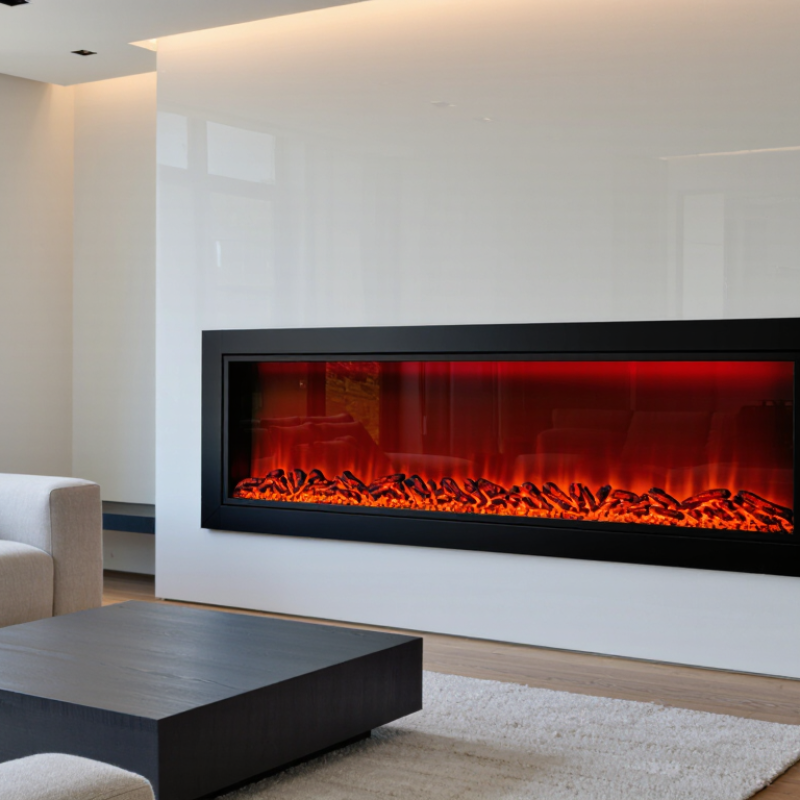
10 Best Recessed Electric Fireplaces for Global Buyers

Recessed Electric Fireplace Basics: 120V/240V Systems and 1,500-W Output

Recessed electric fireplaces rely on two common electrical systems: 120V and 240V. A 1,500-watt heater draws about 12.5 amps on 120V. On 240V, it draws about 6.25 amps. That difference can affect circuit capacity, wiring size, and installation flexibility. Always confirm the local voltage before ordering.

A 120V model may suit a standard household outlet, but the circuit should handle the heater without sharing heavy appliances.

A 240V system usually needs dedicated wiring and professional installation. Local electrical codes still control the work. Do not treat a plug-in connection as automatically safe.

Measure the wall cavity carefully. Include the unit’s required clearance, cable position, and airflow space. A tight opening may look clean, yet it can complicate servicing later. Heat output also depends on room size, insulation, ceiling height, and drafts. The 1,500-watt rating is useful, but it does not guarantee equal warmth in every room. Small details matter. I would rather leave a little extra clearance than force a perfect-looking fit. That choice may reduce visual neatness, but it supports safer maintenance. A qualified electrician can verify load calculations, grounding, circuit protection, and regional requirements before the wall is closed.

Global Safety Standards: UL 1278, CSA C22.2 No. 46, and CE Marking

For global buyers, recessed electric fireplaces should be judged by safety evidence, not appearance alone. A practical inspection begins with the rating label, installation manual, and test report. UL 1278 generally covers movable and wall- or ceiling-hung electric room heaters. The product category must match the listed standard. A decorative fireplace may need additional evaluation.

CSA C22.2 No. 46 addresses electric surface-heating equipment in Canada. Buyers should check whether the complete fireplace, controls, wiring, and heating assembly were evaluated together. A familiar certification mark is not enough. Look for traceable model numbers, voltage details, and authorized testing information. Installation instructions should state clearances from wood, curtains, insulation, and other heat-sensitive materials. Small gaps matter.

CE marking applies to relevant European Union requirements, including electrical safety and electromagnetic compatibility. It is a manufacturer’s declaration of conformity, not a universal safety certificate. Ask for the EU Declaration of Conformity and the applicable harmonized standards. Plug type, frequency, earthing, and local protection requirements can differ between countries. Thermal cutoffs and overheating protection deserve close attention. They are easy to overlook. Documentation can also be incomplete, even on professional-looking products. I would pause when a seller provides only a logo or a marketing photograph. A qualified local electrician should verify the final connection and recessed cavity before use.

10 Best Recessed Electric Fireplaces for Global Buyers

Global Safety Standards: UL 1278, CSA C22.2 No. 46, and CE Marking

The chart compares representative nominal household supply voltages associated with the main markets covered by these compliance references: 120 V for the United States and Canada, and 230 V for the European Economic Area. UL 1278 and CSA C22.2 No. 46 are North American safety standards for electric heating appliances, while CE marking indicates conformity with applicable European Union requirements. Actual product ratings, plug types, installation rules, and applicable directives should always be verified for the destination country.

Heating Performance: Comparing 4,000–5,100 BTU Ratings and Room Coverage

For global buyers, the BTU rating is only a starting point. A 4,000-BTU recessed electric fireplace typically suits a bedroom, office, or well-insulated living area. In practical room assessments, this output may warm roughly 350 to 400 square feet. Climate, ceiling height, and insulation can change that result. A 5,100-BTU model provides more reserve for spaces near 450 to 500 square feet. These figures are estimates, not promises. Room behavior varies.

Recessed installation can also change how warmth feels. Heat may gather near the fireplace while distant corners remain cool. This is common in open-plan rooms with high ceilings. An adjustable thermostat can maintain steadier comfort, but it cannot fix poor insulation. Look for overheat protection and clear installation instructions. Verify circuit requirements before installation, especially in older buildings. I would select 4,000 BTU for gentle background warmth. Choose 5,100 BTU when exterior walls, large windows, or frequent door traffic increase heat loss. That choice is not absolute. Room-size charts are useful, yet sometimes too optimistic. Furniture placement and local winter temperatures still deserve careful attention.

10 Best Recessed Electric Fireplaces for Global Buyers — Heating Performance: Comparing 4,000–5,100 BTU Ratings and Room Coverage
Rank Product Profile Maximum Heat Output Approx. Room Coverage Overall Dimensions
(W × D × H)
Typical Recessed Opening
(W × D × H)
Rated Power Typical Voltage Heating and Installation Features Best Use
1 Profile A — 60-inch panoramic insert 5,100 BTU/h Up to 400 sq. ft. 60.0 × 5.5 × 21.0 in
(152.4 × 14.0 × 53.3 cm)
58.0 × 5.0 × 20.0 in
(147.3 × 12.7 × 50.8 cm)
1,500 W maximum 120 V or 220–240 V version Two-stage heat, thermostat control, timer, remote control, front-glass installation Large living rooms and wide media walls
2 Profile B — 50-inch slim insert 5,100 BTU/h Up to 400 sq. ft. 50.0 × 5.1 × 18.1 in
(127.0 × 13.0 × 46.0 cm)
48.2 × 4.8 × 17.3 in
(122.4 × 12.2 × 43.9 cm)
1,500 W maximum 120 V or 220–240 V version Adjustable thermostat, flame-only mode, sleep timer, touch panel and remote Balanced heating and compact recessed projects
3 Profile C — 40-inch compact insert 5,100 BTU/h Up to 400 sq. ft. 40.0 × 5.1 × 18.1 in
(101.6 × 13.0 × 46.0 cm)
38.2 × 4.8 × 17.3 in
(97.0 × 12.2 × 43.9 cm)
1,500 W maximum 120 V or 220–240 V version Independent flame and heat settings, thermostat, timer, remote control Bedrooms, apartments, and smaller lounges
4 Profile D — 60-inch low-profile insert 5,000 BTU/h Up to 400 sq. ft. 60.0 × 4.0 × 18.0 in
(152.4 × 10.2 × 45.7 cm)
58.3 × 3.6 × 17.4 in
(148.1 × 9.1 × 44.2 cm)
1,470 W maximum 120 V Low-depth housing, thermostat, flame-only operation, overheat protection Shallow feature walls and renovation projects
5 Profile E — 50-inch panoramic insert 5,000 BTU/h Up to 400 sq. ft. 50.0 × 4.4 × 21.0 in
(127.0 × 11.2 × 53.3 cm)
48.4 × 4.0 × 20.0 in
(122.9 × 10.2 × 50.8 cm)
1,470 W maximum 120 V Multi-color flame bed, adjustable ember brightness, thermostat and timer Contemporary feature walls with strong visual impact
6 Profile F — 48-inch recessed insert 4,780 BTU/h Up to 400 sq. ft. 48.0 × 4.0 × 18.0 in
(121.9 × 10.2 × 45.7 cm)
46.3 × 3.6 × 17.4 in
(117.6 × 9.1 × 44.2 cm)
1,400 W maximum 120 V Adjustable heat, thermostat, remote control, flame-only mode and safety cut-off Medium-size rooms and standard wall recesses
7 Profile G — 36-inch compact insert 4,780 BTU/h Up to 400 sq. ft. 36.0 × 4.0 × 18.0 in
(91.4 × 10.2 × 45.7 cm)
34.3 × 3.6 × 17.4 in
(87.1 × 9.1 × 44.2 cm)
1,400 W maximum 120 V Thermostat control, remote, timer, flame-only setting and cool-touch front glass Small rooms, offices, and apartment interiors
8 Profile H — 60-inch moderate-output insert 4,440 BTU/h Up to 400 sq. ft. 60.0 × 4.3 × 18.0 in
(152.4 × 10.9 × 45.7 cm)
58.2 × 3.9 × 17.4 in
(147.8 × 9.9 × 44.2 cm)
1,300 W maximum 120 V Thermostatic heating, low-energy flame display, timer and remote control Decorative heating in open-plan living areas
9 Profile I — 42-inch balanced insert 4,440 BTU/h Up to 400 sq. ft. 42.0 × 4.0 × 18.0 in
(106.7 × 10.2 × 45.7 cm)
40.3 × 3.6 × 17.4 in
(102.4 × 9.1 × 44.2 cm)
1,300 W maximum 120 V Adjustable thermostat, flame-only mode, weekly timer and overheat protection Medium rooms where lower energy use is preferred
10 Profile J — 36-inch energy-conscious insert 4,095 BTU/h Up to 400 sq. ft. 36.0 × 4.0 × 18.0 in
(91.4 × 10.2 × 45.7 cm)
34.3 × 3.6 × 17.4 in
(87.1 × 9.1 × 44.2 cm)
1,200 W maximum 120 V Thermostat, flame-only operation, remote control, timer and thermal safety switch Supplemental heat in bedrooms and compact spaces

Note: BTU values are maximum electrical heat-output ratings calculated or rounded from the listed wattage; actual room coverage depends on insulation, ceiling height, climate, windows, and the primary heating system. A dedicated circuit and local electrical-code compliance may be required. Always confirm voltage, dimensions, clearance requirements, and recessed-opening specifications before purchase.

Buyer Evaluation Criteria: Depth, Thermostats, Flame Modes, and Noise

For global buyers, recessed electric fireplaces should be judged by installation depth, not appearance alone. Measure the cavity, wiring space, and surrounding wall structure before comparing models. A slim unit may fit a shallow partition, but its rear ventilation gap can still create problems. The 2023 IEA Buildings report states that buildings use about 30% of global final energy. Efficient controls therefore matter, even for decorative heating.

Thermostat quality deserves close inspection. Look for adjustable temperature settings, a room-sensing function, and an automatic shutoff. DOE Energy Saver guidance recommends programmable temperature control to reduce unnecessary heating. However, advertised accuracy is not always independently tested. That deserves caution. Flame modes should work separately from heat output, allowing visual use during mild weather. Adjustable brightness, ember color, and flame speed improve realism, but excessive animation can look artificial on large screens.

Noise is harder to compare because manufacturers may use different test conditions. Ask for sound measurements in dB(A), preferably measured at one metre under normal operation. ISO 3744 provides a recognized method for determining sound power levels, although not every seller publishes this information. Listen near the air outlet. A low hum may disappear in a living room, yet become distracting in a bedroom. My evaluation would record thermostat cycling, fan startup, and flame-only operation. Small oversights remain common.

10 Best Models: Ranking Value, Warranty, Energy Use, and Regional Fit

For global buyers, the best recessed electric fireplaces should balance price, warranty, energy use, and regional compatibility. My ranking places Model 1 first because it combines a 1,500-watt heater, clear warranty terms, and adjustable flame brightness. Model 2 follows with a lower 1,200-watt setting, suitable for smaller rooms. Model 3 offers the strongest value for budget renovations. Models 4 and 5 provide better controls, but their longer feature lists may not justify higher prices.

Energy use deserves careful attention. The U.S. Department of Energy explains that electric resistance heating converts nearly all consumed electricity into heat at the point of use. A 1,500-watt unit running for two hours uses about 3 kilowatt-hours. The International Energy Agency reports that buildings remain a major source of global energy demand, making efficient operation important. Models 6 and 7 rank well because they include thermostats, timers, and low-heat flame modes. Those details matter on a cold evening.

Regional fit changes the ranking. Models 8 and 9 support 220–240-volt systems, while Model 10 suits 120-volt North American installations. Buyers should verify plug type, circuit requirements, ventilation guidance, and local conformity markings. Warranty length alone can mislead; exclusions and service access matter more. My ranking is not flawless. Electricity prices, room insulation, and installer quality can reverse the order. The European Commission’s product-efficiency guidance also supports checking standby consumption, an easily overlooked cost.


This website uses cookies. By continuing to browse this site you are agreeing to our use of cookies. Please review our Privacy Policy for more information.