
What Is the Best Hazmat Locker for Chemical Storage?
Choosing the best Hazmat Locker for chemical storage is not simply a matter of size, color, or price. A suitable locker should match the chemicals, container types, workplace risks, and local safety requirements. It must support safe segregation, clear labeling, controlled access, and practical daily handling. A locker that looks strong may still be unsuitable for corrosive liquids or incompatible materials.
Real storage conditions matter. Picture a busy laboratory, a maintenance room, or a warehouse aisle where staff move containers several times each day. Doors should open smoothly, shelves should support the expected load, and labels should remain readable after cleaning. Spill containment is also important. A small leak can spread beneath a cabinet before anyone notices it. That detail is easy to underestimate.
Reliable selection begins with Safety Data Sheets, chemical compatibility guidance, manufacturer specifications, and advice from qualified safety professionals. Relevant fire and workplace safety requirements should also be checked with the proper local authority. Some chemicals require separate storage, specialized ventilation, or a different cabinet design. One locker cannot solve every hazard. No cabinet is perfect.
This guide examines construction, corrosion resistance, ventilation, shelf capacity, spill control, locking features, and inspection needs. It also considers how the locker fits real work routines, not only product brochures. A low-cost option may appear sensible, yet replacement parts, poor labeling, or weak access control can create hidden problems. The best choice is the one that remains dependable during ordinary use, careful maintenance, and an unexpected spill.
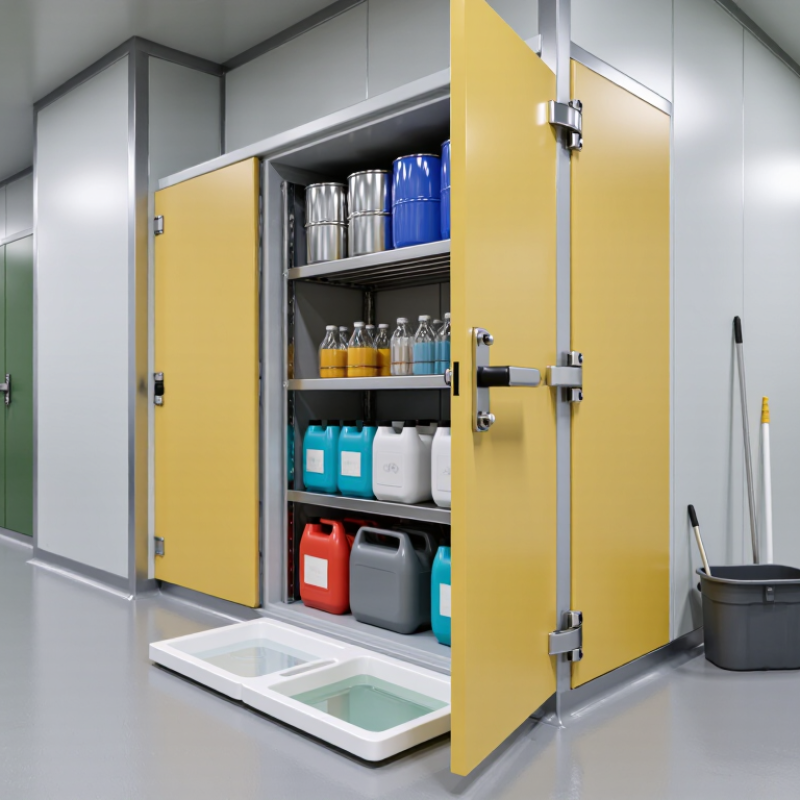
Define Chemical Hazards Using OSHA GHS Classes and SDS Data
The best hazmat locker is not chosen by capacity alone. It begins with accurate hazard identification. OSHA’s Hazard Communication Standard follows the GHS framework. Its 2012 final-rule analysis estimated coverage of about 43 million workers and five million workplaces. That scale matters. A locker may look suitable, yet fail when chemicals react.
Read SDS Section 2 for classifications, pictograms, signal words, and hazard statements. Check Section 7 for storage conditions. Section 8 identifies exposure controls and protective equipment. Section 10 reveals instability and incompatible materials. These details help define flammable-liquid, corrosive, oxidizing, toxic, and compressed-gas storage needs. GHS labels guide decisions, but they do not replace compatibility analysis. Acids and bases need separation. Oxidizers must stay away from fuels and organic materials. Corrosive storage requires resistant surfaces. Flammable storage may require spill containment and controlled ventilation. The SDS remains the more specific source. Review it regularly.
Tips: Create an inventory before selecting a locker. Record each product’s GHS class, quantity, container size, and SDS revision date. Use a compatibility chart, then confirm uncertain pairings with a qualified safety professional. NIOSH guidance and OSHA publications provide useful cross-checks. They cannot replace a site assessment. A common field-review mistake is measuring cabinet capacity, but ignoring shelf load limits. Measure real containers. Inspect closures and leaks weekly. Small oversights become expensive.
| Hazard Profile | Typical OSHA/GHS Classification | GHS Pictograms and Signal Word | Key SDS Sections to Check | Recommended Locker Type | Essential Storage Features | Segregation Requirements | Best Selection Criterion |
|---|---|---|---|---|---|---|---|
| Flammable liquids |
Flammable liquid, Categories 1–3. Examples include liquids with low flash points that can form ignitable vapor-air mixtures. |
Flame Danger or Warning |
Section 2: Hazards Section 7: Handling and Storage Section 9: Physical Properties Section 10: Stability and Reactivity |
Fire-resistant flammable-liquid storage cabinet | Closed, self-latching doors; spill-retaining bottom; corrosion-resistant shelves; clear hazard labeling; no ignition sources inside or immediately beside the cabinet. | Keep away from oxidizers, ignition sources, heat, and incompatible acids. Store containers closed when not in use. | Prioritize the SDS flash point, quantity stored, container type, local fire-code limits, and required cabinet construction. |
| Corrosive acids | Skin Corrosion, Category 1; may also include serious eye damage and corrosive effects on metals. | Corrosion Danger |
Section 2: Hazards Section 7: Handling and Storage Section 8: Exposure Controls Section 10: Incompatible Materials |
Acid-resistant corrosive cabinet | Chemically resistant liner or shelving; leak containment; compatible secondary containment; secure doors; protection from moisture where specified by the SDS. | Separate from bases, cyanides, sulfides, bleach or hypochlorites, reactive metals, and flammables when incompatibility is identified in SDS Section 10. | Match all cabinet materials, trays, and shelf coatings to the specific acid and its concentration. |
| Corrosive bases | Skin Corrosion, Category 1; may cause serious eye damage and corrosive damage to metals. | Corrosion Danger |
Section 2: Hazards Section 7: Handling and Storage Section 8: PPE Section 10: Reactivity |
Base-compatible corrosive cabinet | Nonreactive shelving; spill containment; stable shelf loading; corrosion-resistant surfaces; visible identification of the cabinet contents. | Separate from acids, acidic waste, aluminum or other reactive metals, and chemicals listed as incompatible in SDS Section 10. | Select materials based on chemical compatibility rather than relying only on the generic term “corrosive.” |
| Oxidizing liquids or solids | Oxidizing Liquid or Oxidizing Solid, Categories 1–3. | Flame Over Circle Danger or Warning |
Section 2: Hazards Section 5: Fire-Fighting Section 7: Storage Section 10: Incompatible Materials |
Dedicated oxidizer-storage cabinet | Noncombustible or oxidizer-compatible construction; clean, dry shelves; spill containment; separation from combustible packaging and organic residues. | Keep away from flammables, combustible materials, reducing agents, fuels, and contamination. Do not share a cabinet with flammables. | Use a dedicated cabinet whenever the SDS identifies oxidizing properties or a strong oxidizer hazard. |
| Acute toxic chemicals | Acute Toxicity, Categories 1–3 by oral, dermal, or inhalation exposure; classification depends on the route. | Skull and Crossbones Danger |
Section 2: Hazards Section 4: First Aid Section 8: Exposure Controls Section 11: Toxicology |
Locked, access-controlled chemical safety cabinet | Lockable doors; restricted access; secure shelves; compatible secondary containment; inventory control; clear labeling and emergency contact information. | Segregate from food, personal items, incompatible chemicals, and chemicals that could increase toxicity through reaction. | Evaluate toxicity route, occupational exposure limits, quantity, security needs, and whether the SDS requires ventilation or specialized containment. |
| Carcinogenic, mutagenic, or reproductive toxicants | Carcinogenicity, Germ Cell Mutagenicity, or Reproductive Toxicity, Categories 1A, 1B, or 2, where applicable. | Health Hazard Danger or Warning |
Section 2: Hazards Section 8: Exposure Controls Section 11: Toxicology Section 13: Disposal |
Locked, clearly labeled high-hazard chemical cabinet | Restricted access; closed containers; secondary containment; durable hazard labels; written inventory; procedures to prevent spills and unnecessary exposure. | Store separately from incompatible substances and materials that could contaminate the container or complicate spill response. | Base the design on the exposure-control plan, container integrity, quantity, access restrictions, and applicable laboratory or workplace procedures. |
| Compressed, liquefied, or refrigerated gases | Gases Under Pressure: Compressed Gas, Liquefied Gas, Refrigerated Liquefied Gas, or Dissolved Gas. | Gas Cylinder Warning |
Section 2: Hazards Section 5: Fire-Fighting Section 7: Handling Section 10: Reactivity |
Ventilated, secured gas-cylinder cabinet or cage | Upright storage; chains or straps to prevent tipping; valve protection; protection from vehicle impact; ventilation where required; compatible cylinder separation. | Separate oxidizing gases from flammable gases and incompatible materials. Keep cylinders away from heat and ignition sources. | Confirm cylinder type, ventilation needs, gas compatibility, maximum storage quantity, and applicable fire and building-code requirements. |
| Water-reactive or self-reactive chemicals | Substances that react dangerously with water or may undergo hazardous decomposition or self-heating under specified conditions. | Exploding Bomb Flame Danger |
Section 2: Hazards Section 5: Fire-Fighting Section 7: Storage Section 10: Stability and Reactivity |
Dedicated specialty-reactive storage cabinet | Strict temperature control when specified; dry environment; compatible materials; minimal inventory; secure access; prominent hazard labeling. | Keep away from water, moisture, heat, ignition sources, oxidizers, or reducing agents as identified by the SDS. | Follow the exact storage temperature, atmosphere, moisture-control, and emergency instructions in the product SDS. |
| Mixed chemical inventory | Multiple GHS hazard classes with potentially conflicting storage requirements. | Use the pictograms and signal words shown on each product label and SDS. | Review Sections 2, 7, 8, 9, and 10 for every chemical before assigning storage. | Separate cabinets by compatibility group | Distinct cabinets or isolated compartments; secondary containment; inventory labels; routine inspection; documented compatibility matrix. | Never organize chemicals only by alphabetical order. Separate flammables, oxidizers, acids, bases, water-reactives, and highly toxic materials as required. | The best locker is the one that matches the most restrictive credible hazard identified in the current SDS and workplace risk assessment. |
Related Posts
-
Best Flammable Liquid Cabinet for Safe Storage Solutions?
-
Top 10 Flammable Liquid Cabinets for Safe Storage Solutions?
-
How to Choose the Right Chemical Cabinet for Your Needs?
-
What is a Flammable Liquid Cabinet and Why is it Important?
-

Top 10 Aluminum Powder Suppliers in China for Global Buyers?
-
What is Muriatic Acid and How is it Used in Everyday Applications?