
Choosing the best Water Chiller for your business is not simply a matter of selecting the largest cooling capacity. It requires a careful look at production loads, operating hours, water temperature, available space, and long-term maintenance. A chiller that performs well in a clean factory may struggle in a dusty workshop or a facility with unstable power. The details matter.
Dr. Moncef Krarti, a recognized building-energy specialist, has stated, “Energy efficiency is not a product; it is a process of continuous improvement.” This principle applies directly to Water Chiller selection. An efficient unit should match the real cooling demand, not an imagined peak that occurs only a few hours each year. Oversizing can increase purchase costs, short cycling, and unnecessary energy use. Undersizing may cause unstable temperatures, production delays, and early compressor wear.
Look beyond the nameplate. Compare cooling capacity, coefficient of performance, refrigerant type, pump requirements, noise levels, control systems, and service support. Ask whether technicians can reach the filters, condenser, and electrical cabinet without dismantling half the machine. That practical detail is easy to overlook. It should not be.
There is no universally perfect Water Chiller. That is the uncomfortable part. A lower-cost air-cooled model may suit a small facility, while a water-cooled system may deliver better efficiency for continuous industrial operation. Yet site conditions can change the decision. This guide examines the critical factors, common mistakes, and realistic selection methods that help businesses choose a reliable chiller for today’s workload and tomorrow’s expansion.
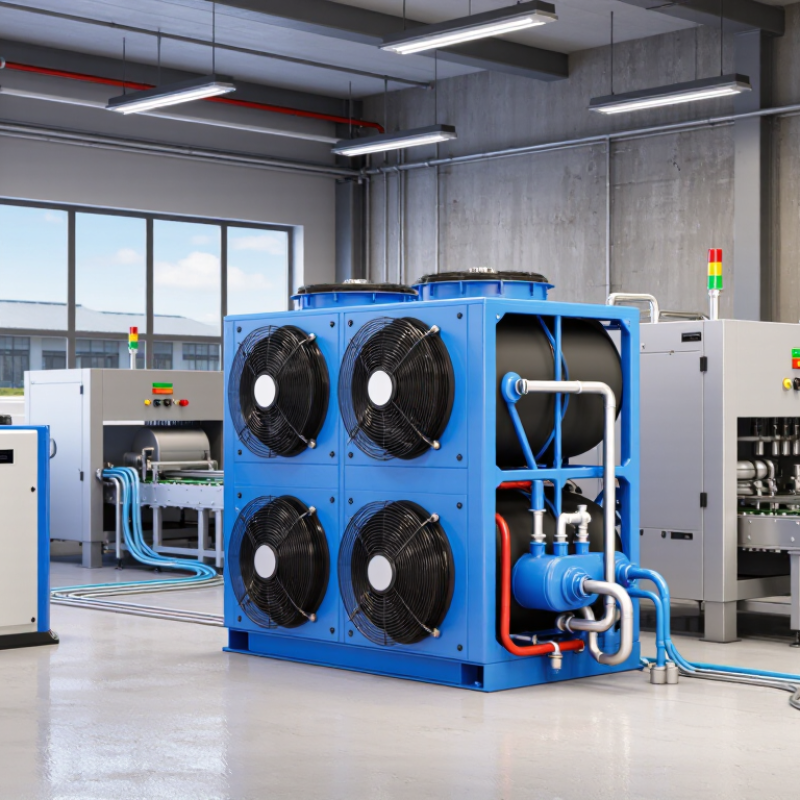
Define Business Cooling Demand: 1 kW Refrigeration Equals 3,412 Btu/h
Choosing a water chiller starts with measured cooling demand, not a catalog number. One kilowatt of refrigeration equals 3,412 Btu/h. For example, a 50 kW load requires about 170,600 Btu/h. This conversion helps teams compare suppliers using the same technical language. It also prevents a common mistake: confusing electrical input with refrigeration capacity.
Calculate heat from the process, pumps, motors, nearby equipment, and room conditions. Add heat entering through open doors or warm materials. A production line may need 35 kW, while connected equipment adds another 8 kW. A modest safety margin, often 10% to 20%, can cover seasonal changes. Oversizing looks safe, but it may cause short cycling and unstable water temperatures.
A practical assessment should record supply temperature, return temperature, flow rate, and ambient conditions. Check whether the process needs plain water or a glycol mixture. Review evaporator limits, condenser airflow, controls, water quality, and service access.
A perfect calculation is rare. That is worth admitting. Field conditions change, and initial assumptions can be wrong. Recheck the load after installation, especially during the busiest production period.
A reliable chiller choice balances verified capacity, stable control, energy use, and maintainable operation.
At the standard 7–12°C range, a chiller supplies water at 7°C and receives it near 12°C. This five-degree difference affects flow, pump energy, and heat-transfer performance. The AHRI 550/590 standard uses defined rating conditions, helping buyers compare capacity and efficiency more reliably. However, published ratings rarely match every factory floor. Dirt, unstable loads, and poor control settings can change results.
Air-cooled chillers reject heat through outdoor coils and fans. They need no cooling tower, reducing water treatment, maintenance, and installation complexity. They also perform well where water is scarce or rooftop placement is practical. Their weakness appears during hot afternoons. Rising outdoor temperatures can increase condensing pressure and electrical demand.
Water-cooled chillers usually reject heat through a cooling tower. The U.S. Department of Energy identifies them as generally more energy-efficient than air-cooled systems, especially under steady commercial loads. ASHRAE guidance also recognizes the benefit of lower condensing temperatures. The trade-off includes tower fans, pumps, water treatment, and Legionella-control procedures. The International Energy Agency projects global space-cooling energy demand could more than triple by 2050, making lifecycle efficiency increasingly important. Still, selecting only by COP is imperfect. A small plant with variable production may waste energy running a large water system. A 7–12°C design should be checked against local weather, water availability, load profile, and measured part-load performance.
The best water chiller is not chosen by price alone. Verify COP, flow rate, and operating stability under AHRI 550/590 conditions. COP equals cooling capacity divided by electrical input. A higher COP usually means lower energy use, but part-load performance matters more in many facilities. AHRI 550/590 evaluates full-load and integrated part-load efficiency through IPLV or NPLV ratings.
Check the actual flow rate at your design temperature difference. For example, a 7°C supply and 12°C return may require different flow than your process needs. Confirm pump pressure, water quality, and control accuracy.
Log supply temperature, return temperature, flow, current, and alarms for at least 24 hours.
Measure it yourself. A datasheet can look excellent. Field conditions may disagree.
IEA’s The Future of Cooling reports that cooling represents nearly 10% of global electricity consumption, making efficiency verification financially important.
Tips:
Request certified test data, not only laboratory claims. Compare COP at your expected load. Ask for AHRI 550/590 rating conditions and tolerances. Review performance at 25%, 50%, 75%, and 100% load. A stable chiller should hold temperature without frequent compressor cycling. Keep a record of seasonal performance. This step is often missed.
What Is the Best China Water Chiller for Your Business?
Match Refrigerants, Materials, and Safety Compliance to Site Conditions
The best China water chiller begins with the site, not the catalogue. Check outdoor temperature, altitude, dust, humidity, and available electrical capacity. A coastal plant may need corrosion-resistant panels and coated coils. A dusty workshop may require stronger filtration and easier cleaning access. Small details matter.
Refrigerant selection should reflect room layout, ventilation, and local safety requirements. Lower-impact refrigerants can reduce environmental burden, but some require stricter leak detection and ventilation controls. Confirm the refrigerant’s safety class, pressure range, service procedures, and documentation before ordering. Do not assume a familiar refrigerant suits every facility. That assumption can become expensive.
Water quality also changes the material decision. Copper tubes may perform well in clean systems, while aggressive water can demand different alloys or treatment. Stainless steel components can improve resistance, but they do not remove every corrosion risk. Ask for water analysis, not guesses. Include flow switches, pressure protection, emergency stops, and accessible isolation valves. Verify compliance certificates against the installation country’s current requirements. During commissioning, record temperatures, pressures, flow rates, alarms, and refrigerant details. A perfect specification rarely exists. Recheck it after the first hot-season operation.
| Chiller Configuration | Typical Capacity Range | Suitable Refrigerants | Refrigerant Safety Class | Recommended Site Conditions | Preferred Heat-Exchanger Materials | Main Advantages | Key Limitations | Important Compliance Checks |
|---|---|---|---|---|---|---|---|---|
| Air-Cooled Scroll Chiller | Approximately 20–500 kW cooling capacity | R-410A, R-32, R-454B, or lower-GWP alternatives selected for the equipment design | Depends on refrigerant: A1 for non-flammable options; A2L for mildly flammable options | Sites with limited water supply, moderate maintenance requirements, and adequate outdoor airflow | Copper tubes with aluminium fins for normal atmospheres; coated or epoxy-protected coils for coastal or corrosive air | Simple installation, no cooling tower, lower water consumption, and suitable for many commercial facilities | Performance decreases at high outdoor temperatures; fan noise and coil fouling must be considered | Electrical safety, pressure-vessel protection, refrigerant charge limits, ventilation, service access, and applicable local A2L requirements |
| Water-Cooled Scroll Chiller | Approximately 100–1,000 kW cooling capacity | R-410A, R-513A, R-134a in legacy designs, or other refrigerants approved for the selected compressor and heat exchanger | Typically A1 for common non-flammable refrigerants; verify the exact refrigerant designation | Facilities with reliable condenser-water supply, cooling towers, and trained water-treatment personnel | Copper or stainless-steel tubes; stainless steel is preferred where water chemistry or chloride exposure is aggressive | More stable high-load performance and generally better heat rejection than air-cooled systems in hot climates | Requires cooling towers, pumps, water treatment, drainage, and regular condenser cleaning | Condenser-water treatment, Legionella risk management where applicable, pressure protection, electrical compliance, and local building regulations |
| Air-Cooled Screw Chiller | Approximately 300–1,500 kW cooling capacity | R-134a or lower-GWP replacements such as R-513A, subject to compressor and system approval | Commonly A1; confirm the safety classification on the nameplate and documentation | Large factories, logistics buildings, process cooling, and projects requiring robust part-load operation | Copper/aluminium air coils; stainless steel or protected metalwork for humid, salty, or chemically contaminated environments | High capacity, good turndown potential, and fewer water-side components than a water-cooled plant | Large footprint, higher outdoor-air heat rejection demand, and possible acoustic impact | Machinery guarding, pressure relief, electrical protection, structural loading, noise limits, and service clearances |
| Water-Cooled Screw Chiller | Approximately 500–3,000 kW cooling capacity | R-134a, R-513A, or other refrigerants specifically qualified for the screw compressor system | Often A1, but the final classification is refrigerant-specific | Central utility plants with high annual operating hours and sufficient mechanical-room infrastructure | Evaporator and condenser tubes selected according to water quality; stainless steel or enhanced alloys may be required for corrosive water | High capacity, efficient heat rejection, and effective operation for large continuous loads | Higher installation complexity and dependence on pumps, cooling towers, water treatment, and specialist service | Pressure equipment rules, mechanical-room ventilation, water-treatment procedures, electrical standards, and refrigerant handling regulations |
| Low-GWP A2L Refrigerant Chiller | Commonly available from small commercial systems to medium-capacity packaged units | R-32, R-454B, or R-1234ze(E), depending on the system design and applicable regulations | A2L: lower toxicity and mildly flammable | Projects prioritising lower global-warming impact and prepared to manage mildly flammable refrigerants | Materials must be compatible with the refrigerant, lubricant, pressure, and operating temperature; copper and approved elastomers are commonly used | Lower GWP than many legacy HFC options and better alignment with refrigerant-transition policies | Requires charge-limit assessment, suitable leak detection or airflow controls where required, ignition-source control, and trained technicians | Check ISO 5149, EN 378, IEC 60335-2-40, or the locally adopted equivalent; confirm installation, ventilation, signage, and service requirements |
| Process Water Chiller | Approximately 5–1,500 kW, depending on process temperature and load profile | Refrigerant chosen according to required leaving-water temperature, pressure range, efficiency, and local environmental rules | A1 or A2L options are possible; confirm the exact safety class before installation | Plastic processing, food production, laser equipment, electronics, laboratories, and other applications requiring stable water temperature | Stainless steel, copper, titanium, or corrosion-resistant plastics selected according to water chemistry and process-fluid compatibility | Precise temperature control, custom pumps and tanks, and compatibility with continuous industrial operation | Process contaminants, glycol concentration, low-temperature operation, and rapid load changes can reduce capacity or efficiency | Verify operating envelope, pump safety, freeze protection, pressure testing, emergency shutdown, electrical standards, and process risk assessments |
| High-Ambient Outdoor Chiller | Capacity must be selected at the project design ambient; commonly 20–1,500 kW | Refrigerant and compressor combination approved for the specified high-condensing-temperature range | A1 or A2L depending on the selected refrigerant | Hot climates, rooftop installations, dusty industrial zones, and locations with limited mechanical-room space | UV-resistant coatings, corrosion-protected coils, stainless fasteners, and weatherproof electrical enclosures | Maintains dependable operation where outdoor temperatures, solar exposure, dust, or humidity are significant | Higher condensing pressure can increase energy use; actual capacity may be substantially lower than nominal rating at standard conditions | Confirm capacity at design ambient, IP enclosure rating, wind and snow loads, lightning protection, noise limits, and refrigerant safety provisions |
What Is the Best China Water Chiller for Your Business?
The best China water chiller is not always the cheapest unit on the quotation. A realistic 10–20-year cost review should include energy, installation, maintenance, and downtime. For example, a chiller running 6,000 hours yearly can consume far more money than its purchase price. Compare power input, cooling capacity, seasonal efficiency, and expected load patterns. Use your electricity rate, not a generic estimate.
Installation costs may include piping, pumps, controls, electrical work, lifting, and commissioning. A compact unit could reduce room preparation, but restricted airflow may increase operating costs. Maintenance also needs honest forecasting. Budget for water treatment, filter cleaning, refrigerant checks, sensor replacement, and compressor service. Request service records and component availability before signing. Experience shows that delayed spare parts can extend downtime, even when the equipment itself performs well.
Tips: Build three cost scenarios: normal, heavy-load, and delayed-maintenance. Calculate annual energy use, then add installation and service expenses. Keep a contingency reserve of 10–15%. This is not perfect, because future electricity prices and production schedules may change. Still, transparent assumptions make supplier comparisons more reliable. Ask for measured performance data, warranty conditions, and a written response-time commitment. Small details matter.
Estimated 10–20-year total cost of ownership for a representative 100 kW process-chilling application. Costs are shown in USD and include electricity, installation, and routine maintenance.
Assumptions: 4,000 operating hours per year, electricity at $0.12/kWh, 100 kW cooling capacity, and no major component replacement. The high-efficiency water-cooled configuration has the lowest long-term cost because its higher installation complexity is offset by lower electricity consumption. Actual results depend on load profile, climate, water treatment, operating temperature, and local utility rates.
This website uses cookies. By continuing to browse this site you are agreeing to our use of cookies. Please review our Privacy Policy for more information.
