
Choosing the right Infrared Thermometer in 2026 requires more than comparing prices and screen sizes. Global buyers face different working conditions, user expectations, and measurement risks. A forehead model may suit clinics and households. A rugged industrial unit may better serve maintenance teams, kitchens, laboratories, or electrical inspections. Fixed infrared sensors also support continuous monitoring in production environments.
Professor Michael Vollmer, a physicist and infrared thermography researcher, offers a practical reminder: “Temperature measurement depends on the measurement conditions.” That principle deserves attention. Surface emissivity, distance, viewing angle, airflow, humidity, and reflected heat can change the displayed result. Even an advanced Infrared Thermometer can produce an unreliable reading when the target is shiny, moving, dusty, or poorly positioned.
Small details matter.
This guide examines the leading Infrared Thermometer types for global buyers, including medical, industrial, contactless spot, fixed-mount, and thermal imaging models. It compares accuracy claims, temperature ranges, response time, repeatability, calibration support, battery design, display readability, and protection ratings. It also considers practical purchasing issues, such as multilingual manuals, service availability, data logging, and regional product requirements.
No device is perfect.
Some manufacturers present laboratory accuracy under carefully controlled conditions. Real workplaces are less forgiving. Buyers should question impressive specifications and examine test methods, target size, calibration records, and operating limitations. This review is designed to support informed decisions, not automatic trust. The best model is the one that matches the target surface, measurement distance, environment, and user skill. That match is often overlooked.
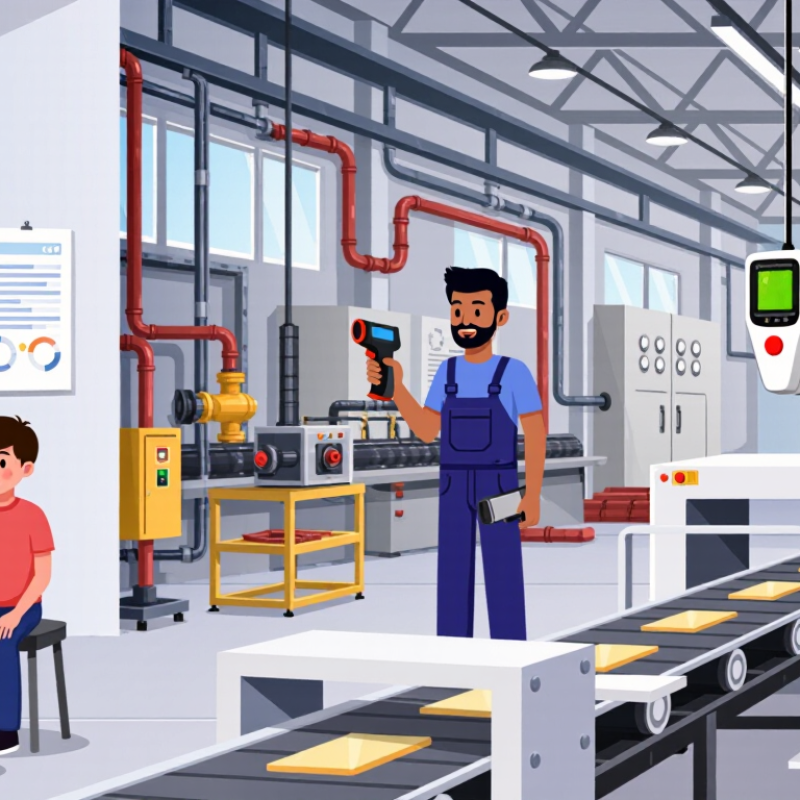
An infrared thermometer estimates temperature without touching the surface. Every object emits infrared energy, and warmer surfaces generally emit more. Inside the device, an optical lens focuses this energy onto a sensor. Electronics then convert the signal into a temperature reading.
The measurement is not magic. It is an estimate.
The National Institute of Standards and Technology explains that infrared readings depend on emissivity, reflected radiation, distance, and the instrument’s calibration. Human skin often has high emissivity, near 0.98, but sweat, dust, hair, or a cold forehead can disturb the result. ISO 80601-2-56 also requires clinical thermometers to control accuracy and operating conditions. These details matter during purchasing.
A 2024 industry market report from Grand View Research projects continued growth in non-contact temperature measurement, driven by healthcare, manufacturing, and food inspection. Growth does not remove basic limitations. A thermometer may read a warm surface rather than internal body temperature. Its distance-to-spot ratio also matters. A 12:1 model measures a 1-centimeter area from 12 centimeters away. Wider targets can mix hot and cold zones.
Keep the lens clean. Let the device adjust to room conditions. Aim at the same area each time. Avoid direct sunlight and strong airflow. ASTM E1965 provides performance guidance for infrared thermometers, but real users still make errors. I have seen readings shift after moving only a few centimeters. That small change deserves attention.
What an Infrared Thermometer Is and How It Measures Temperature
Infrared thermometers estimate temperature by detecting infrared energy emitted from an object's surface without physical contact. The chart shows representative temperature ranges commonly available for major thermometer types. Actual specifications vary by model, target material, emissivity, distance-to-spot ratio, and ambient conditions.
2026 Best Infrared Thermometer Types for Global Buyers
Infrared thermometers differ mainly by target, sensing distance, and measurement purpose. Spot thermometers read surface temperature from a distance. They suit machinery, food lines, and electrical panels. Their accuracy depends on emissivity, viewing angle, and distance-to-spot ratio. A small target can produce a misleading reading.
Forehead and ear thermometers are designed for human temperature screening. Ear models measure heat near the eardrum, while forehead models scan the temporal area without contact. Their readings can shift after outdoor exposure, sweating, or incorrect positioning. Thermal imaging systems show temperature patterns across a larger area. They help locate abnormal heat, but they need calibration and trained interpretation. Fixed infrared sensors offer continuous monitoring in production environments. They prioritize stability and fast response over portability.
The difference is practical. Fast does not always mean accurate. According to Fortune Business Insights’ 2024 market analysis, the global infrared thermometer market was valued at about USD 1.13 billion in 2024 and may reach roughly USD 1.69 billion by 2032. This growth reflects wider use across healthcare, manufacturing, food processing, and building inspection. ISO 80601-2-56 emphasizes performance requirements for clinical thermometers, while industrial users often examine ASTM E1965 guidance and calibration records. Buyers should compare stated accuracy, operating range, emissivity settings, and test conditions. One overlooked detail: a clean lens matters. Even a good sensor can fail in dusty, reflective, or rapidly changing environments.
2026 Best Infrared Thermometer Types for Global Buyers
Matching a thermometer to the job matters more than choosing the highest specification. Non-contact infrared models suit clinics, kitchens, warehouses, and busy inspection lines. They measure quickly without touching skin or surfaces. However, steam, dust, sunlight, and reflective metal can distort readings. Contact probes often provide better control for food, liquids, and laboratory samples. Ear and forehead models may fit healthcare settings, but user training remains important. Small errors can affect decisions.
Global buyers should compare operating temperature ranges, measurement distance, emissivity settings, and response time. A Celsius/Fahrenheit switch helps international teams. Battery availability also matters in remote regions. Check calibration certificates, user instructions, warranty terms, and local product requirements before purchasing. Independent testing is more convincing than attractive packaging. Field experience shows that many buyers underestimate storage conditions. Extreme heat can damage accuracy before the device is used.
Tips: Match the sensor to the surface. Use a probe for liquids and a non-contact model for moving objects. Test reflective materials at different angles. Keep a reference thermometer nearby. Record unusual readings instead of ignoring them. A lower-cost option may perform well, but only after practical verification. 恒一
| Thermometer Type | Measurement Principle | Typical Temperature Range* | Best Measurement Site or Target | Main Advantages | Main Limitations | Best-Match Global Buyer Needs | Key Buying Checks |
|---|---|---|---|---|---|---|---|
| Forehead Non-Contact Medical IR Thermometer | Detects infrared radiation from the forehead and estimates body temperature without skin contact. | Usually about 32–42.9 °C (89.6–109.2 °F) for body mode; device limits vary. | Forehead or temporal area. | Fast, hygienic, easy to use, and suitable for screening several people with minimal disturbance. | Readings can be affected by sweat, hair, headwear, cosmetics, direct sunlight, drafts, and acclimatization time. | Homes, schools, clinics, pharmacies, workplaces, travel settings, and markets requiring contact-free checks. | Medical-device registration, Celsius/Fahrenheit switching, adjustable emissivity or body-mode calibration, distance guidance, fever alarm, and multilingual instructions. |
| Tympanic Ear IR Thermometer | Measures infrared radiation from the tympanic membrane and surrounding ear canal. | Usually about 34–42.2 °C (93.2–108.0 °F) in body mode; device limits vary. | Ear canal, using the correct probe position. | Rapid response and generally good agreement with core temperature when correctly positioned. | Requires correct insertion and angle; earwax, small ear canals, ear coverings, and recent exposure to hot or cold conditions may affect results. | Hospitals, pediatric care, eldercare, and buyers prioritizing quick clinical measurements. | Disposable probe-cover availability, cleaning procedure, age-mode settings, fever thresholds, storage conditions, and local clinical compliance. |
| Temporal Artery Scanner | Scans infrared emissions over the temporal artery, commonly across the forehead toward the hairline. | Typically designed for approximately 34–42.2 °C (93.2–108.0 °F); model limits vary. | Temporal artery and forehead route. | Fast, low-contact operation and potentially more consistent than a single forehead spot when the scanning technique is correct. | Technique-sensitive; sweat, hair, head coverings, and incorrect scanning speed can reduce reliability. | Clinical facilities and professional caregivers needing efficient repeated measurements with limited cross-contact. | Clear scanning instructions, repeatability data, cleaning requirements, battery life, display readability, and training materials for different regions. |
| Handheld Industrial IR Thermometer | Measures infrared radiation from a surface and converts it to an estimated surface temperature. | Common product ranges span approximately −50 to 550 °C (−58 to 1,022 °F); high-temperature models can extend higher. | Machinery, electrical panels, bearings, pipes, HVAC equipment, food surfaces, and other accessible targets. | Non-contact inspection, quick troubleshooting, broad temperature coverage, and portability. | Measures surface rather than internal temperature; reflective or shiny materials, steam, dust, distance, and incorrect emissivity settings can cause errors. | Maintenance teams, factories, building services, food operations, laboratories, and field technicians. | Distance-to-spot ratio, adjustable emissivity, response time, calibration certificate, environmental rating, laser safety class, and data logging. |
| Fixed-Mount Industrial IR Sensor | Continuously detects infrared radiation from a defined target area and outputs a temperature signal for monitoring or control. | Often selected from ranges such as −20 to 500 °C (−4 to 932 °F); specialized models cover wider ranges. | Moving production lines, ovens, kilns, conveyors, electrical assets, and process equipment. | Continuous measurement, automation compatibility, reduced manual inspection, and alarm or control integration. | Requires correct installation, stable alignment, suitable target visibility, power, and protection from the operating environment. | Manufacturers seeking process control, predictive maintenance, quality monitoring, and reduced production downtime. | Analog or digital output, industrial communication protocol, mounting accessories, ingress protection, calibration interval, response time, and integration support. |
| Infrared Thermal Imaging Camera | Uses an infrared detector array to create a thermal image and display temperature patterns across multiple points. | Many general-purpose units cover roughly −20 to 550 °C (−4 to 1,022 °F); specialized cameras may differ. | Large areas, electrical systems, buildings, mechanical assemblies, solar equipment, and concealed heat patterns. | Shows temperature distribution, identifies hotspots, supports documentation, and measures multiple areas at once. | Higher purchase cost, larger data volume, lower measurement certainty on reflective surfaces, and a learning curve for image interpretation. | Energy auditors, electrical inspectors, maintenance contractors, construction teams, and advanced industrial users. | Detector resolution, thermal sensitivity, visual camera, focus method, image storage, software compatibility, emissivity controls, and calibration traceability. |
| Food-Safety IR Thermometer | Measures infrared radiation from food or packaging surfaces without direct contact. | Commonly about −50 to 300 °C (−58 to 572 °F), depending on the product design. | Food surfaces, refrigerated displays, storage areas, cooking equipment, and receiving inspections. | Fast hygiene checks, useful for sealed packages and moving goods, and easy to clean when designed for food environments. | Surface readings do not confirm the internal temperature of food; packaging, condensation, steam, and reflective surfaces may affect results. | Restaurants, catering operations, supermarkets, cold-chain logistics, food processors, and hospitality businesses. | Food-contact material requirements, waterproof or washdown rating, HACCP-compatible procedures, calibration checks, probe compatibility, and temperature logging. |
| Medical IR Thermometer with Contact Probe Option | Combines infrared body-temperature measurement with a separate contact probe for oral, axillary, or other supported measurements. | Body-temperature mode is commonly around 32–42.9 °C (89.6–109.2 °F); contact-probe ranges vary by design. | Forehead or supported contact sites, depending on the selected mode. | Provides operational flexibility when non-contact readings need confirmation or when different patient groups require different methods. | More complex cleaning, training, storage, and workflow requirements than a single-mode thermometer. | Clinics, mobile medical teams, care facilities, pharmacies, and buyers serving mixed-use healthcare environments. | Mode-specific accuracy documentation, probe hygiene, disposable covers, alarm settings, battery replacement, regulatory approval, and recordkeeping functions. |
Choosing an infrared thermometer in 2026 requires more than comparing screen size and price. Global buyers should identify the measurement type first: forehead, ear, or industrial surface. Clinical models should reference recognized performance requirements, such as IEC 80601-2-56, where applicable. Accuracy claims should include a tolerance, test distance, ambient conditions, and calibration method. A reading of 37.0°C means little without this information.
Look for calibration records traceable to a qualified national or accredited laboratory. Resolution is not accuracy. A display showing 0.1°C can still measure poorly. In field checks, cold rooms, sweaty skin, direct sunlight, and incorrect distance can shift results. No thermometer is perfect. Even careful users sometimes trust a stable number too quickly. For medical screening, repeat unusual readings and follow local health guidance rather than relying on one device.
Tips: Keep the sensor clean and dry. Let the thermometer adjust to the room before use. Aim at the recommended body area without touching the skin. Check batteries before travel, and store the unit away from heat and moisture. For ear models, use the correct position and consider disposable covers where hygiene rules require them. Buyers should also review electromagnetic compatibility, battery safety, language instructions, warranty terms, and local import requirements. These details seem minor, but they often decide whether a device remains dependable after months of daily use.
For global buyers, supplier comparison should begin with measurement evidence, not catalog photos. ISO 80601-2-56 defines safety and essential performance requirements for clinical thermometers. Ask suppliers for test reports showing accuracy across stated temperature ranges, distances, and ambient conditions. A 2023 WHO procurement guide also stresses clear specifications, user training, and maintenance planning for reliable medical equipment. These details matter in humid warehouses and busy clinics.
Certification claims require careful checking. Request the certificate number, issuing body, scope, and expiry date. ISO 13485 supports quality-management assessment, while IEC 60601-1 addresses electrical safety for applicable devices. Regulatory registration may still differ by destination. Confirm the importer’s obligations before placing a large order. Cheap compliance documents can be surprisingly expensive later.
Compare total purchase cost over the product’s working life. Add calibration checks, replacement batteries, spare units, freight, duties, software, and warranty returns. A 2024 medical-device market assessment by Grand View Research projects sustained growth in infrared diagnostic equipment, increasing supplier competition but also documentation risk. The lowest quotation is not always economical. It may exclude calibration or after-sales support. Request three sample units and test them against a calibrated reference thermometer. Keep a written record. Procurement teams sometimes trust a certificate more than real-world performance, and that is a mistake worth revisiting.
This website uses cookies. By continuing to browse this site you are agreeing to our use of cookies. Please review our Privacy Policy for more information.
