2026 Best Types of Conveyor Equipment for Global Buyers
Choosing the right conveyor system can shape a facility’s safety, output, and long-term operating cost. For global buyers, the decision involves more than comparing belt widths or motor ratings. Material type, product weight, route length, climate, cleaning routines, and available floor space all matter. A dusty quarry needs different equipment from a pharmaceutical packing line. Small details often decide performance.
This guide examines the best types of Conveyors Equipment for 2026, including belt, roller, chain, screw, slat, bucket, and modular conveyor systems. Each option has practical strengths and limits. Belt conveyors suit continuous movement across long distances. Roller conveyors support cartons and pallets efficiently. Screw conveyors handle powders, but product friction and heat require careful evaluation. These differences should be matched with real production conditions, not attractive catalogue images.
Reliable purchasing also depends on supplier experience and documented evidence. Buyers should review load calculations, motor efficiency, guarding design, spare-parts access, installation support, and maintenance records. Compliance with applicable safety standards must be confirmed for each destination market. A low purchase price may hide costly downtime later. It happens more often than expected.
No single conveyor design fits every facility. Even a well-researched selection can need adjustment after installation. Site trials, operator feedback, and transparent performance data remain valuable. The following overview helps purchasing teams compare equipment with greater confidence, while recognizing that practical results depend on sound engineering and honest supplier communication.
Conveyor Equipment: Definition, Purpose, and Main Operating Principles
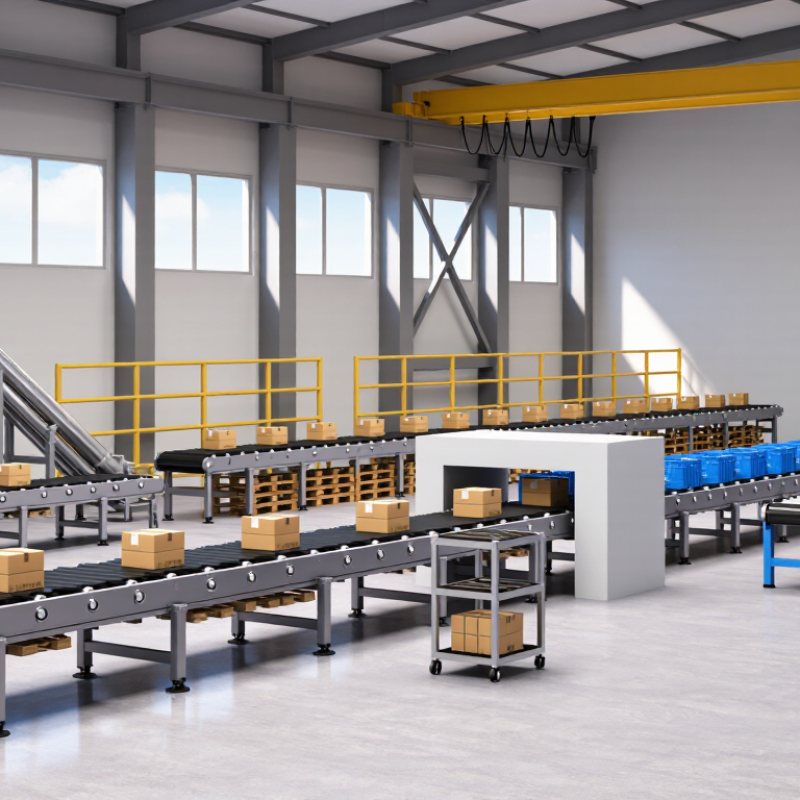
Conveyor equipment is a mechanical system that moves materials between defined points with controlled effort. It may use belts, rollers, chains, or screws, depending on the load and route. Unlike manual handling, it creates a repeatable flow through warehouses, factories, mines, and distribution centers.
Its purpose is practical: reduce lifting, improve movement speed, and maintain steady production. A typical system includes a frame, conveying surface, drive unit, tensioning parts, and safety controls. The drive motor produces torque. Power then reaches the belt or rollers through pulleys, gears, or chains. Friction carries the material forward. Gravity may assist movement on inclined sections.
Operating principles depend on accurate matching. A heavy carton needs stronger support and suitable roller spacing. Loose powder requires sealed transfer points and controlled speed. Sensors can detect gaps, jams, or misplaced loads, while emergency stops help limit risks. In plant assessments, small details often decide performance. Dust near a drive pulley can increase wear. Poor alignment can make a belt drift.
A conveyor may look efficient on paper. It may still fail during seasonal peaks. Designers should check load changes, cleaning access, noise, maintenance space, and operator visibility. One overlooked transfer point can slow an entire line. The best selection is not always the fastest system. It is the system that remains predictable, serviceable, and suitable for real working conditions.
How to Compare Capacity, Speed, Power, and Space Requirements
2026 Best Types of Conveyor Equipment for Global Buyers
How to Compare Capacity, Speed, Power, and Space Requirements
When comparing conveyor equipment in 2026, capacity should lead the discussion. Measure peak hourly load, average load, product weight, and loading frequency. A system moving 500 cartons per hour may need 800-carton capacity during seasonal surges. Do not size only for today. Leave practical headroom, but avoid paying for unused structure and motors. Belt conveyors often provide steady movement for fragile goods. Roller conveyors can suit rigid packages and controlled accumulation.
Speed must match upstream production, picking accuracy, and worker response time. High speed can increase damage, noise, and emergency stops. Compare meters per minute with product spacing and transfer distance. Then check acceleration. Power calculations should include incline angle, belt tension, friction, load weight, and startup demand. Ask for motor duty data, not only a headline rating. A qualified engineer should show these assumptions in writing.
Space can change the best equipment choice. Map floor length, ceiling height, columns, walkways, service access, and turning points. Do not forget maintenance clearance. My first layout estimate once looked efficient, but it blocked a useful inspection path. That mistake was avoidable. Use a scaled drawing and verify dimensions at the site. A short trial with representative products can expose jams, noise, or unstable loading before full installation. Real operating data is usually more reliable than a catalog estimate.
2026 Best Types of Conveyor Equipment for Global Buyers
How to Compare Capacity, Speed, Power, and Space Requirements
Belt Conveyor Typical speed: 0.5–7 m/s. Installed power: 5–500 kW. Best for long-distance, high-capacity conveying, but it requires more floor space.
Roller Conveyor Typical speed: 0.1–2 m/s. Installed power: 0.1–30 kW. Suitable for cartons, pallets, and unit loads with modular layouts.
Screw Conveyor Typical speed: 0.1–1 m/s. Installed power: 2–75 kW. A compact option for powders, grains, and other bulk materials over short distances.
Bucket Elevator Typical speed: 1–4 m/s. Installed power: 5–150 kW. Uses vertical space efficiently for lifting bulk materials between levels.
Pneumatic Conveyor Typical conveying velocity: 15–35 m/s. Installed power: 15–300 kW. Requires limited floor space but generally consumes more energy.
The chart shows representative maximum throughput values for common conveyor categories. Actual capacity depends on material density, conveyor width, incline, loading method, route length, and operating conditions. Use speed, power, and available space together when comparing equipment.
Global Buying Factors: Safety Standards, Maintenance, Costs, and Suppliers
Global buyers should evaluate conveyor equipment through safety, maintenance, total cost, and supplier capability. Safety begins with a documented risk assessment, not a product brochure. ISO 12100 supports systematic machine risk reduction, while ISO 13849-1 addresses safety-related control systems. Buyers should request guarding layouts, emergency-stop testing records, and noise measurements. Local electrical rules still apply. A familiar design can be unsafe in a different facility.
Maintenance costs often decide long-term value. The U.S. Department of Energy reports that predictive maintenance can reduce maintenance costs by 25–30% and downtime by 35–45%. For conveyors, this means checking belt alignment, bearing temperature, motor vibration, and spare-parts availability. MHI’s 2024 Annual Industry Report found that 55% of supply-chain professionals planned to increase technology investment. Yet automation is not always the best answer. A complex sensor system may exceed the skills of a small maintenance team. I have seen “smart” equipment become expensive when basic cleaning was neglected.
Tips: Ask suppliers for five-year ownership estimates, not only purchase prices. Confirm response times, training, manuals, and local service coverage. Test one conveyor section under real load before full deployment. Compare energy use at start-up and normal operation. Question every promised uptime figure. It may be technically correct, but still unsuitable for your site.